Comments
CITY COUNCIL - I recently attended a Los Angeles City Council meeting expecting seriousness, professionalism, and urgency equal to the crises now confronting this city. Instead, I witnessed screaming, profanity, chaos, and a level of public distrust so palpable it hung in the room like smoke.
At one point, two speakers erupted into angry profanity-filled tirades while councilmembers appeared almost numb to the spectacle, continuing on as if this level of civic breakdown had become routine. Sitting there, I remember thinking: How did we get here?
Then I realized something uncomfortable.
People are no longer simply angry about taxes.
They are losing faith that Los Angeles is functioning competently at all.
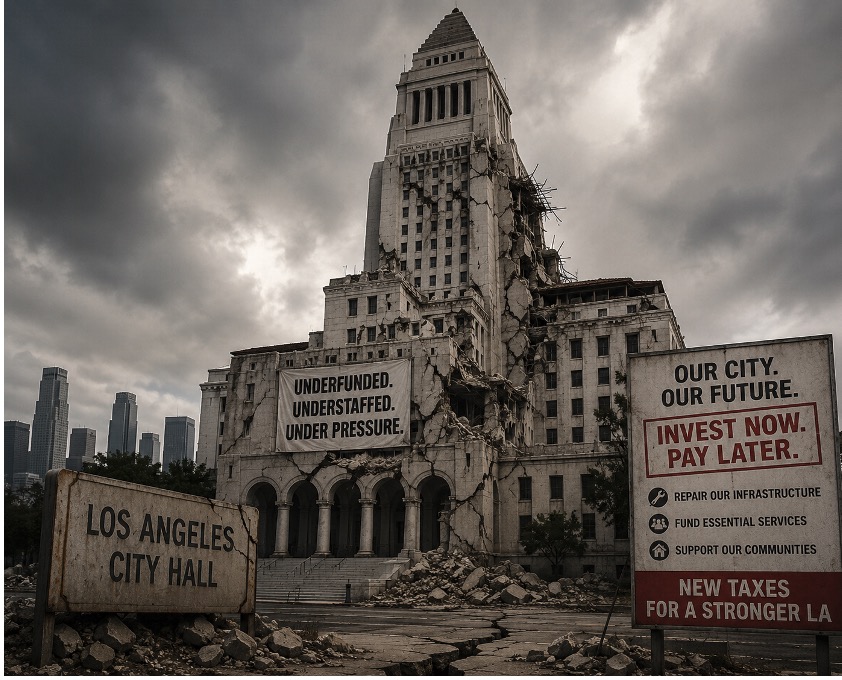
And that matters because City Hall is now approaching residents once again with discussions of new taxes, new revenue measures, new bonds, and additional public funding to address an increasingly severe budget crisis.
But before Los Angeles asks struggling residents for another dollar, the public has the right to ask a fundamental question:
Has City Hall truly reformed itself?
Because from the perspective of many residents across the San Fernando Valley and beyond, Los Angeles does not appear to be suffering from a temporary revenue problem.
It appears to be suffering from structural failure.
The city’s financial problems are real. Mounting legal payouts, infrastructure deterioration, wildfire-related pressures, pension obligations, labor costs, deferred maintenance, and slowing economic conditions are creating enormous strain on the municipal budget. Public reporting now shows liability payouts reaching staggering levels while city officials openly warn about layoffs, service reductions, and worsening deficits.
This is not imaginary.
But neither is the growing frustration of taxpayers who increasingly feel they are paying more while receiving less.
Roads continue deteriorating. Emergency response systems remain strained. Residents endure worsening traffic congestion, infrastructure instability, recurring power outages during major fire events, and growing public safety concerns. Entire neighborhoods increasingly question whether the systems protecting them can withstand a major regional disaster.
Yet at the very same time, government continues aggressively advancing large-scale development and density expansion throughout already impacted communities without first proving the infrastructure exists to safely support it.
That contradiction is becoming impossible to ignore.
Residents in Granada Hills are currently witnessing these tensions play out in real time through proposals such as the MorningStar assisted living and memory-care development near Rinaldi Street and Shoshone Avenue — a project many community members believe illustrates the growing collision between aggressive density streamlining, wildfire evacuation concerns, infrastructure strain, and public safety limitations in the San Fernando Valley.
Whether one supports or opposes any individual project is ultimately beside the point.
The larger issue is whether Los Angeles has honestly evaluated the cumulative fiscal, infrastructure, emergency-response, and liability consequences associated with continuing large-scale growth in already strained communities.
Unchecked growth without infrastructure readiness does not reduce future costs.
It creates future liabilities.
In fact, one of the most overlooked aspects of Los Angeles’ budget crisis may be the degree to which poor long-term planning decisions themselves are contributing to the city’s growing financial instability.
When government accelerates dense development without proportional investment in evacuation systems, roadway expansion, water infrastructure, electrical resiliency, emergency response capability, wildfire mitigation, and public safety staffing, the consequences do not simply disappear into planning reports.
They eventually reappear as municipal liabilities.
Every preventable wildfire failure, dangerous roadway condition, overwhelmed emergency system, flooding event, utility breakdown, delayed ambulance response, infrastructure collapse, or public-safety failure carries enormous downstream financial consequences — including litigation exposure, emergency expenditures, deferred maintenance costs, insurance pressures, and long-term infrastructure replacement obligations.
In other words, Los Angeles may now be experiencing the financial consequences of years of approving cumulative growth without adequately accounting for cumulative infrastructure capacity.
If that pattern continues, taxpayers may ultimately be asked not only to subsidize government expansion, but also to subsidize the mounting costs of government’s own planning failures.
Part of the problem may be that Los Angeles has increasingly drifted away from true long-term civic planning and toward a model focused on keeping the machinery of government financially operational in the short term.
Departments originally intended to engage in meaningful city planning now often appear heavily incentivized toward application processing, entitlement throughput, development acceleration, fee generation, and compliance with aggressive state housing mandates — while the long-term infrastructure consequences receive far less meaningful attention.
But genuine city planning cannot merely involve determining how quickly projects can be approved.
It must also involve determining whether roads, water systems, electrical infrastructure, emergency response capability, wildfire evacuation networks, hospitals, utilities, and public safety systems can safely sustain the cumulative burdens being imposed upon them.
Otherwise, government risks creating the illusion of economic progress while quietly accumulating massive future liabilities beneath the surface.
And those liabilities eventually arrive — financially, environmentally, and sometimes catastrophically.
At the same time, Los Angeles appears to be underperforming economically in areas where it should dominate.
This city possesses some of the most recognizable tourism and entertainment destinations in the world, yet many public-facing corridors increasingly project disorder, neglect, filth, and unmanaged street conditions that actively undermine tourism confidence and civic pride.
Cities like Chicago long ago understood that protecting and maintaining tourism anchors such as Grant Park and surrounding public spaces was not merely cosmetic — it was economic policy. Visitors who feel safe, welcomed, and impressed generate enormous downstream revenue for restaurants, hotels, retail, entertainment, and local government.
Los Angeles should be leading the world in this category.
Instead, iconic destinations such as Hollywood Boulevard increasingly feel overwhelmed by blight, disorder, aggressive street activity, deteriorating public presentation, and the steady erosion of the beauty and historic character that once made these areas globally admired destinations.
That too carries economic consequences.
Because this is no longer merely a debate about whether taxes should go up.
It is a debate about whether the current model of governance is functional.
Residents are repeatedly told there is “no choice” except more taxes.
But many taxpayers look around and see little evidence that City Hall has undertaken the type of sweeping structural reform expected before asking working families, retirees, and small businesses to shoulder even greater burdens during a time of inflation, rising insurance costs, housing instability, and economic uncertainty.
Has Los Angeles fully audited outside consulting contracts?
Has it aggressively consolidated overlapping administrative functions?
Has it implemented meaningful performance-based budgeting?
Has it conducted a top-to-bottom review of liability prevention?
Has it honestly evaluated whether continuing aggressive development without cumulative infrastructure analysis is fiscally responsible?
Many residents would answer no.
And perhaps most concerning of all is the growing sense that government no longer adequately distinguishes between revenue generation and responsible governance.
The answer to structural dysfunction cannot simply be perpetual taxpayer extraction.
Especially when residents increasingly feel less protected, less heard, and less confident in the institutions requesting more money from them.
The people of Los Angeles are not unreasonable.
Most understand the city faces serious fiscal challenges. Most understand public services require funding. Most support firefighters, police officers, sanitation workers, emergency personnel, and essential city employees who continue serving under increasingly difficult conditions.
But support for public services is not the same thing as blind trust in government management.
Before new taxes are imposed, residents deserve transparency, accountability, measurable reform, and evidence that City Hall is confronting the underlying structural causes of this crisis rather than merely attempting to patch another budget hole.
Because if Los Angeles continues ignoring infrastructure strain, deferred maintenance, wildfire vulnerability, liability exposure, cumulative planning failures, and deteriorating public conditions, no level of taxation will permanently solve the problem.
You cannot tax your way out of structural failure.
(Eva Amar is a Granada Hills community organizer focused on infrastructure, wildfire safety, public accountability, and land-use policy in the San Fernando Valley.)