

AB 747 Passed After California’s Deadliest Fire. Why Isn't City Planning Implementing It?
FIRE IN PARADISE - Eighty-five people died in Paradise.
Not during some distant chapter of California history. Not a generation ago. Not in an era before lawmakers understood the dangers of wildfire evacuation.
Seven years ago.
On the morning of November 8, 2018, the Camp Fire exploded through the town of Paradise with terrifying speed. Entire neighborhoods were engulfed. Families fled through smoke-darkened streets. Parents loaded children into cars. Elderly residents struggled to escape. Thousands of people poured onto a limited roadway network as flames overtook entire sections of the community.
Many never made it out.
Some died in their vehicles. Others were trapped while attempting to evacuate. Entire families became separated amid smoke, gridlock, and chaos. By the time the fire was extinguished, 85 people were dead, nearly 19,000 structures had been destroyed, and an American town had been largely erased from the map.
The Camp Fire remains the deadliest wildfire in California history.
The tragedy exposed a simple but deadly reality: when evacuation planning fails, people die.
But Paradise revealed something even more troubling.
The victims were disproportionately elderly.
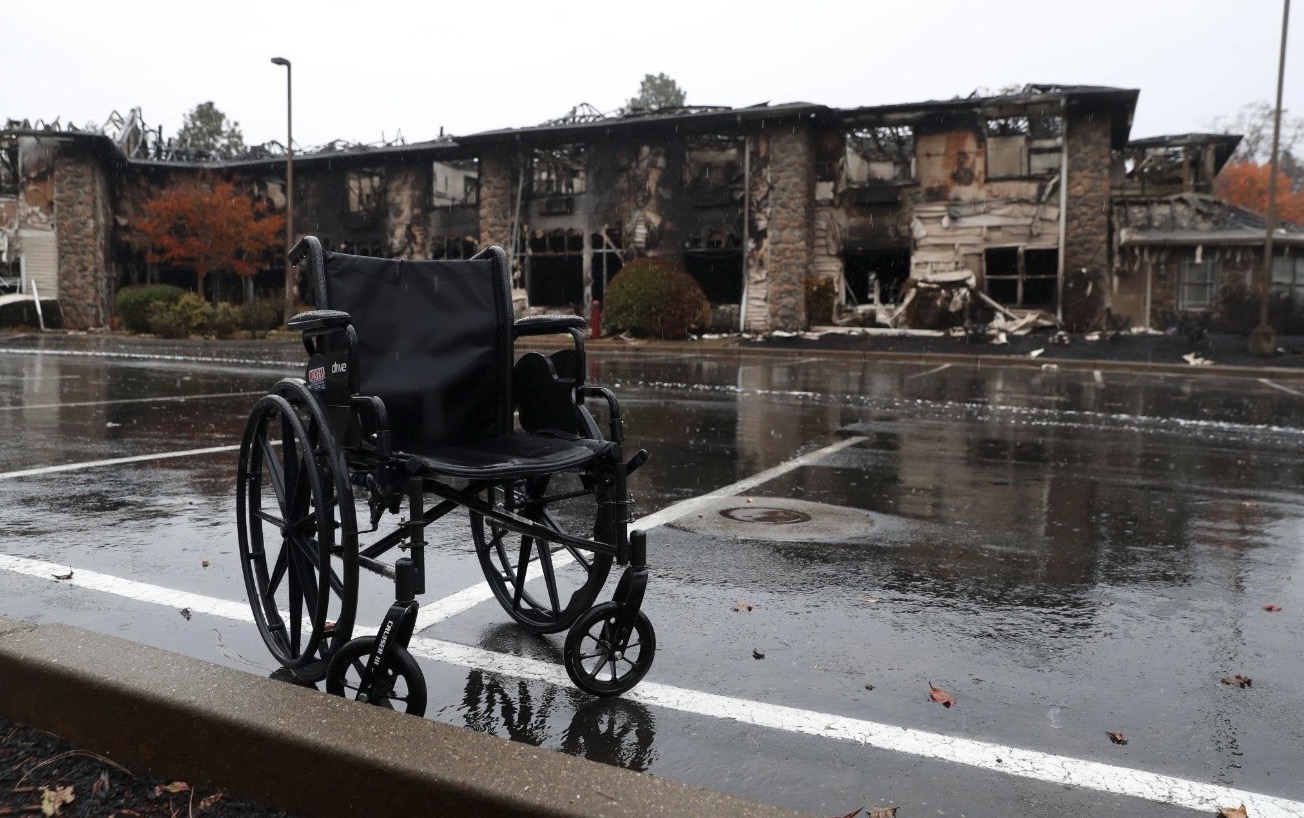
More than three-quarters of the identified fatalities were over the age of 65. Many suffered from mobility limitations, chronic medical conditions, disabilities, cognitive decline, or lacked the ability to rapidly self-evacuate. The very populations least capable of surviving a delayed evacuation proved to be among the most vulnerable when disaster struck.
That should sound familiar.
Because the project now being advanced by Los Angeles City Planning is not an apartment complex filled with healthy adults capable of jumping into their cars and driving away at a moment's notice.
It is overwhelmingly an assisted living and memory care facility.
And California has already learned the dangers associated with evacuating dependent elderly populations during wildfires.
Federal after-action reviews of the Camp Fire documented the extraordinary efforts required to evacuate assisted living facilities, nursing facilities, and senior care homes as flames entered Paradise. Emergency responders, ambulances, staff members, and private citizens worked under impossible conditions to move elderly residents to safety. In some cases, facilities housing well over one hundred residents required massive coordinated evacuations involving multiple agencies and transportation resources.
The lesson was unmistakable.
Evacuating elderly and memory-care residents is fundamentally different from evacuating a conventional residential development.
It takes more time.
It requires more personnel.
It requires more transportation resources.
And when evacuation routes fail, the consequences can be catastrophic.
California lawmakers recognized this reality after Paradise.
In 2019, they enacted AB 747, requiring local governments to identify evacuation routes and evaluate their capacity, safety, and viability under emergency conditions. The purpose was straightforward: ensure that communities understand whether people can actually get out before disaster strikes.
That was not ancient history.
That was seven years ago.
And if anything, California's wildfire risks have only intensified.
Which is why residents of Granada Hills were stunned to discover that while California was still grappling with the lessons of Paradise, Los Angeles City Planning appeared to be fast-tracking a 98-unit assisted living and memory care facility into a constrained wildfire evacuation corridor.
For nearly five years, residents of Granada Highlands and surrounding communities have fought the proposed MorningStar Granada Hills project at Rinaldi Street and Shoshone Avenue. The proposal consists overwhelmingly of assisted living and memory care occupancy—not traditional independent housing—and would place more than one hundred elderly and medically vulnerable residents into an area already facing substantial wildfire evacuation constraints.
The site sits within or immediately adjacent to one of California's highest fire severity classifications. Thousands of existing residents already depend upon Shoshone Avenue and surrounding limited-capacity roadways for evacuation during wildfire emergencies.
Within a short distance are schools, churches, and community gathering facilities. All rely upon the same constrained roadway network during emergency conditions.
Naturally, residents assumed the City must have conducted extensive wildfire evacuation analysis before attempting to streamline a project of this nature.
That assumption did not survive contact with the administrative record.
Residents searching for meaningful evacuation analysis instead found little evidence of the type of rigorous review one would expect for a project housing largely dependent elderly populations.
No meaningful cumulative evacuation modeling.
No serious route-capacity analysis.
No realistic study of how schoolchildren, churches, surrounding neighborhoods, emergency responders, and a large assisted living and memory care facility would simultaneously function during a wildfire evacuation.
After years of environmental review stagnation, City Planning appeared to pivot toward AB 130 streamlining procedures—Sacramento's latest effort to accelerate qualifying housing projects.
And that is where this story stops being merely a neighborhood land-use dispute and becomes a statewide public safety question.
Because California already passed wildfire evacuation legislation.
AB 747 already exists.
It was enacted specifically because people died.
It was enacted because lawmakers concluded that evacuation planning could no longer be treated as an afterthought.
Yet residents repeatedly found themselves being told that AB 130 streamlining had effectively tied everyone's hands, as though a streamlining statute had somehow superseded every other public safety obligation California has enacted.
That explanation never made much sense.
The Legislature did not repeal AB 747.
The Legislature did not eliminate wildfire evacuation planning.
The Legislature did not decide that dependent elderly populations suddenly became easier to evacuate.
The Legislature did not conclude that roads no longer matter.
Quite the opposite.
California enacted AB 747 because roads matter.
Evacuation capacity matters.
And vulnerable populations matter.
Perhaps the most troubling question raised by the MorningStar controversy is not whether the project should ultimately be approved or denied.
It is whether anyone meaningfully asked the question AB 747 was designed to answer:
Can people get out?
Not in theory.
Not on paper.
Not in a consultant's boilerplate narrative.
In the real world.
In smoke.
In panic.
In gridlock.
With schoolchildren.
With church congregations.
With emergency responders trying to get in while residents are trying to get out.
With memory-care residents who cannot simply grab a set of car keys and drive away.
That is the question Paradise forced California to confront.
And it is the question residents of Granada Hills have been asking ever since.
For decades, this community underwent layer upon layer of planning intended to protect its unique character and physical limitations. Studies were performed. Community plans were adopted. Zoning protections were enacted. Public resources were spent evaluating how growth should occur and where it should occur.
Yet increasingly, communities across Los Angeles are watching years of planning swept aside the moment a new streamlining mechanism appears.
The question no longer seems to be:
"Should this project go here?"
The question appears to be:
"How do we get this approved?"
There is a profound difference between those two approaches.
One is planning.
The other is processing.
And perhaps that is the most troubling lesson of all.
AB 747 is not a suggestion.
It is not a talking point.
It is not an optional consideration to be acknowledged and then ignored.
It is California law.
It was written in response to the deadliest wildfire in California history.
It was enacted to protect communities before—not after—the next catastrophe.
Yet today, streamlining appears to be the soup du jour at Los Angeles City Planning, while one of California's most important wildfire safety laws has effectively been 86'd from the conversation.
The people of Paradise paid a terrible price to teach California that evacuation planning matters.
The question now is whether City Planning intends to honor that lesson—or continue processing projects as though the lesson was never learned.
(Eva Amar is the Granada Highlands Community Coordinator and a community advocate focused on land use, wildfire safety, infrastructure planning, government accountability, and public safety issues in Los Angeles.)