

SB 79 In Los Angeles: Is its bark worse than its bite?
PLANNING WATCH - California Senate Bill 79 became law in October 2025. This State housing law takes effect on July 1, 2026, and it require California cities, like Los Angeles, to allow higher-density,1-5 story apartment buildings near major transit stops, as shown on the map below. This law is opposed by many local officials because it will drastically alter zoning laws near transit hubs.
SB 79 also allows buildings 6–9 stories high within a half-mile of major transit stops, including Metro’s B and D lines and key bus rapid transit lines. The law effects areas within a 1/4 mile (higher density) and 1/2 mile (moderate density) of transit stops. Furthermore, projects with more than 10 units must allocate 7-13% of them for lower-income households.
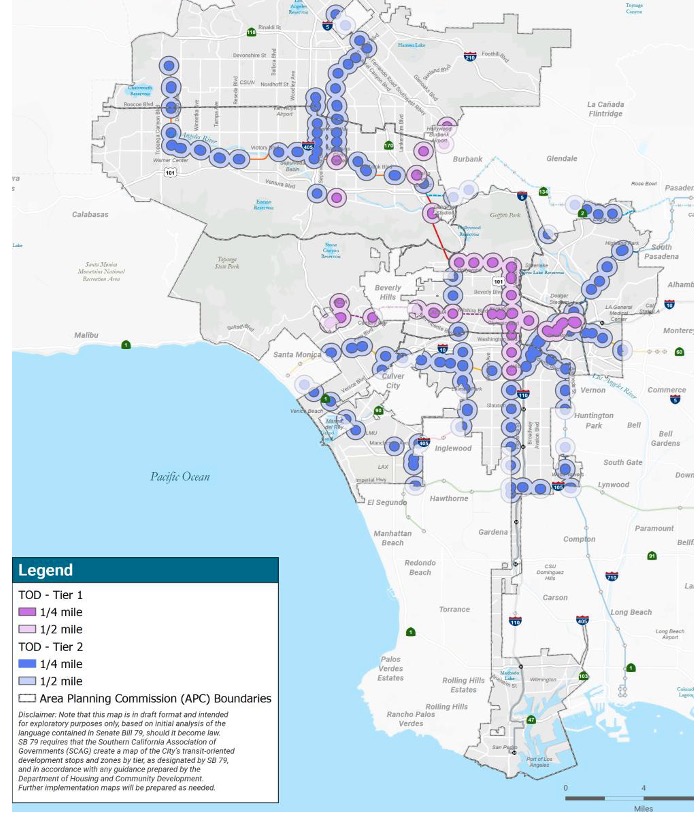
Implementation of SB 79 in Los Angeles: On April 17, 2026, LA City Planning released a draft of its local SB 79 implementation ordinances, including the Low-Rise Ordinance, for which a public hearing is scheduled on May 14, 2026.
LA Mayor Bass and the Metro Board have formally opposed SB 79 because they argue it ignores local neighborhood needs. Furthermore, the LA City Council wants to delay the full roll out of SB 79 until 2030. If alternative ordinances are adopted, they would allow 2-to-4 story, 4-16 unit buildings in designated areas. They would also become a protective land use buffer for areas, such as Historical Preservation Overlay Zones (HPOZ’s), from SB 79’s upzoning.
What to expect from the local implementation of SB 79. On April 17, 2026, LA City Planning released its SB 79 implementation ordinances, including the Low-Rise Ordinance. While it is nearly impossible to foresee the local impacts of a statewide land use ordinance, like SB 79, we need to consider the following. California is already experiencing population loss, and the State’s Department of Finance has disaggregated this loss at the county level. In 2025 they listed the population of LA County at 9,853,435. By 2070 the State projects the County’s population will have shrunk to 8,413,331, a loss of 1,440,122 people. Since most of these residents lived in apartments, we can assume that this decline will free up over 300,000 housing units.
This calculation is not precise because we don’t know the number of homeless people in LA in 2070, but based on the extrapolation of current data, we can assume that most of the homeless will not be able to rent a vacant apartment – unless landlords decide to lose money.
Conclusion: The prediction of housing conditions in Los Angeles County between now and 2070 is general, other than to assume that the steady departure of residents between 2026 and 2070 incrementally frees up apartments. We can also assume that most of those who are homeless or who live in overcrowded conditions cannot afford to rent vacant apartments or buy houses. These are most of the people who leave Los Angeles, and they create a growing inventory of vacant apartments.
The departure of people from Los Angeles will incrementally unfold from now until 2070, the limit of current forecasts. Thei exit will free up apartments as a faster rate than the overcrowded and homeless can fill – assuming they can pay the monthly rent. Since most of them can’t, the homeless and overcrowded populations will still be with us, despite so many vacated apartments and houses.
LA’s housing crisis will not disappear just because the population steadily declines and the number of vacant housing units steadily increases. Furthermore, SB 79 will have a negligible impact because few investors will be willing to buy and demolish existing units, then build a large replacement apartment building in its place. Like so many other Scott Wiener legislative proposals, its bark is worse than its bite.
(Dick Platkin ([email protected]) is a retired LA city planner. He reports on local planning issues and is a board member of United Neighborhoods for Los Angeles. Previous columns are available at the CityWatchLA archives.)