
PLANNING WATCH - Senate Bill 79, the Abundant and Affordable Homes Near Transit Act. was passed by the California State Legislature in October 2025, but it is now on hold in the City of Los Angeles because of its adverse impacts.
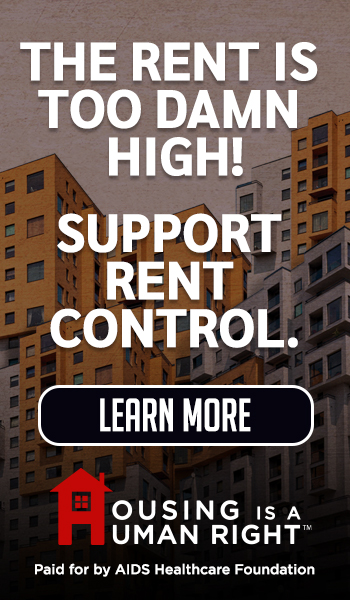
As adopted, SB 79 would override local planning and zoning laws to allow much greater height and residential density in neighborhoods close to transit lines. The photo above shows the potential impact of SB 79, as imagined by the Conservancy.
The two questions I keep asking myself about SB 79 are:
· How would SB 79 increase the number of homeless people in California, especially in Los Angeles and other nearby cities?
· Would the greater residential densities allowed by SB 79 actually appear, even if they were legally permitted?
After all, Los Angeles’s population is steadily declining. This has been calculated by the State of California, and in the long-term, this population decline adds to the supply of vacant apartments. LA City’s population is currently around 3.8 million people and slowly falling. Los Angeles County’s population is estimated to be 9.8 million, and is also declining. More specifically, the California State Department of Finance estimates Los Angeles County’s population will drop to 8.4 million by the year 2070. Presumably, the City’s population will also shrink by a similar amount, to decrease from 3.8 million to 3.25 million by 2070.
Even if the County and City do not add any more housing over the next 44 years, a minimum of 486,000 housing units (1,400,000 people / 2.8 people per unit) will be theoretically freed up through long-term population loss in LA County. Since most of these housing units are apartments, not single family houses, there would be enough newly vacant units, as well as existing vacancies, to house the homeless. Of course, since most of the homeless do not have enough money to rent or buy these units, they would remain vacant. The County’s and city’s vacancy rates would not decline. In fact, they would probably rise.
CONCLUSION: The repeated claims of a housing shortage in LA as the primary cause of homelessness overlooks this obvious trend, as well as the large number of existing and available apartments made available (to house those with enough money to qualify and rent).
What will happen when SB 79 is refined and then rolled out in Los Angeles? In my view, these are the two basic alternatives:
1. Despite SB 79 State legislation, private housing investors would NOT spring into action, and new housing would not materialize in the areas shown on this draft map of SB 79’s corridors in Los Angeles.
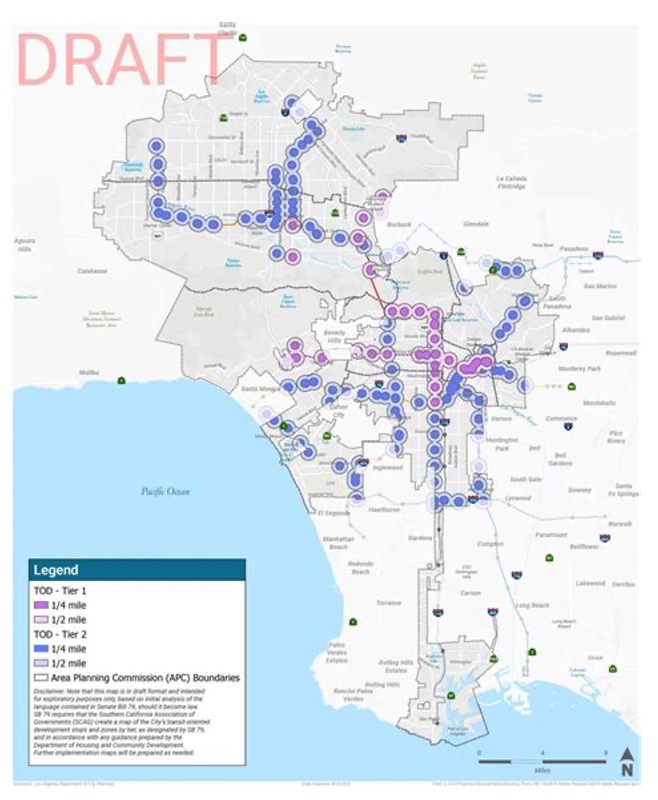
2. Housing investors would take advantage of SB 79, and there would be new apartments built in lieu of existing houses and commercial buildings, as shown in the map above.
But these new apartments would have high vacancy rates because of population decline in Los Angeles City and County. Since the County’s population would decline by 1.4 million people by 2070, this would free up an estimated 429,000 housing units (based on 2.8 people per housing unit.). In the City of Los Angeles there would be as many as 59,000 housing units made vacant because of population loss. This is enough vacant housing to theoretically provide shelter to all of the homeless.
It is hard to know which scenario will prevail, but either way, SB 79 will not stop LA County’s and City’s decline in population and parallel growth in homelessness. Therefore, despite this forecast population loss, there will still be an expansion in the number of vacant and over-priced housing units.
SB 79 will not be a panacea, and it will magnify existing homeless trends.
(Dick Platkin ([email protected]) is a retired LA city planner. He reports on local planning issues and is a board member of United Neighborhoods for Los Angeles. Previous columns are available at the CityWatchLA archives.)