
LA Mayor’s Race: Bass Faces Crowded Field as Homelessness, Safety, and Wildfire Recovery Dominate
MAYORAL RACE - The 2026 Los Angeles mayor’s race is shaping up as a crowded and unusually unpredictable contest, with incumbent Mayor Karen Bass facing more than a dozen challengers and a campaign environment defined by homelessness, public safety, housing affordability, and criticism over the city’s wildfire response.
Bass remains the clear front-runner in most early polling, but she is not yet securing majority support, leaving open the possibility of a runoff if no candidate receives more than 50% in the June 2 primary. That dynamic has helped fuel a race in which a fragmented field of opponents is trying to capitalize on dissatisfaction with City Hall and broader frustration over the city’s direction.
Bass has centered her reelection campaign on making Los Angeles safer and more affordable, while also emphasizing efforts to reduce homeless encampments, revive the economy in Hollywood, and position the city as the nightlife capital of America in a safer way. But she has also come under heavy criticism for her handling of the Palisades Fire and for what opponents describe as a weak response to the city’s ongoing housing and homelessness crises.
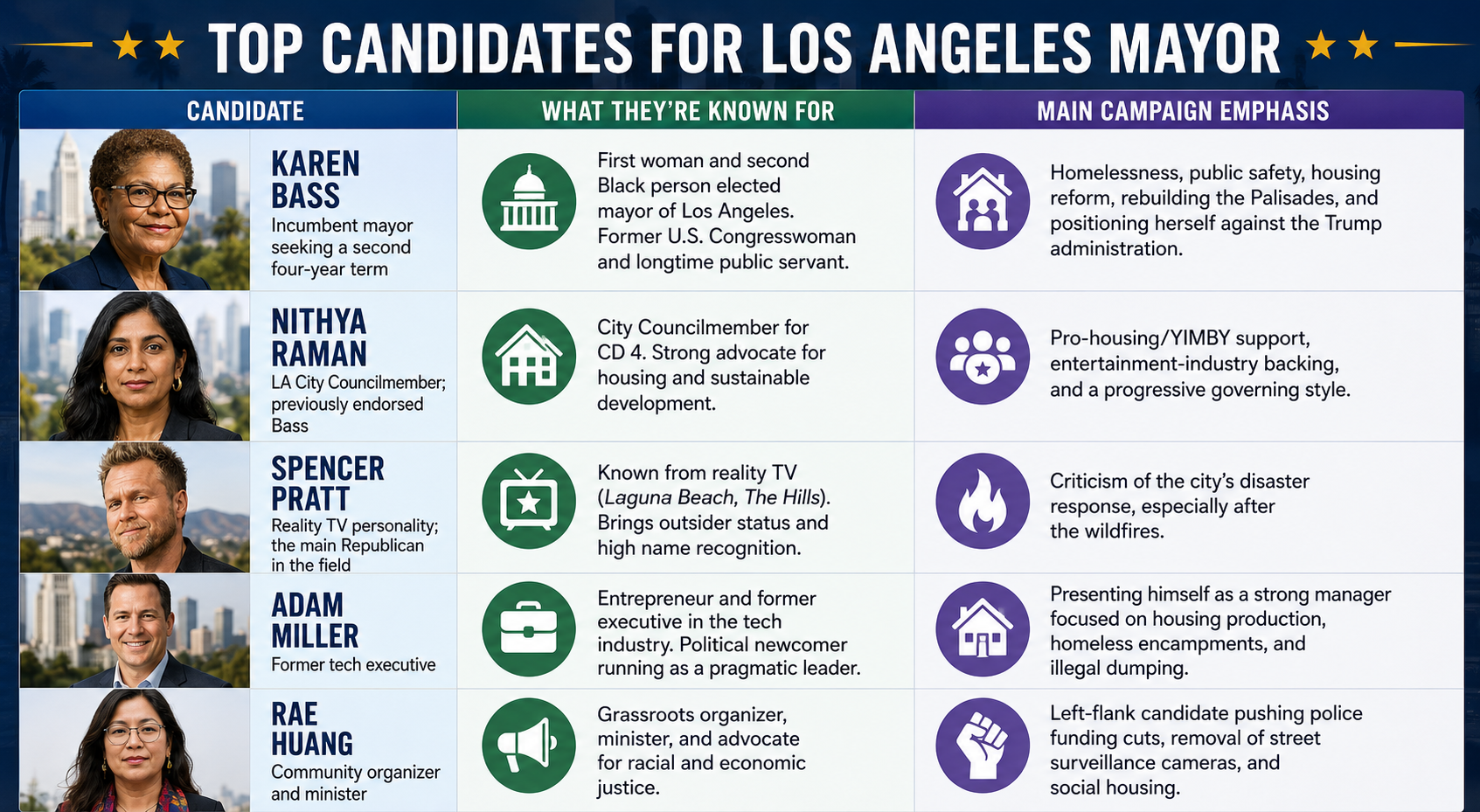
Among the better-known challengers is Nithya Raman, the City Council member who has gained attention as a progressive alternative and, in some polling, has shown enough strength to suggest she could emerge as a serious runoff contender. Raman’s profile is notable because she once aligned with Bass but now finds herself in a race where she is being viewed as one of the candidates best positioned to benefit from dissatisfaction among voters looking for change.
Another prominent name in the race is Spencer Pratt, whose campaign is centered less on traditional policy platforms than on anger over the city’s disaster response. Pratt has framed his candidacy around the devastation of the fire that destroyed his home, turning his campaign into a sharp critique of the current administration’s handling of emergency preparedness and recovery.
The rest of the field reflects the fractured nature of the race. Candidates are running on a wide range of themes including transparency and accountability, housing stability, homelessness, budget discipline, traffic reduction, rent reduction, Metro improvements, and public safety. Some are pitching themselves as pragmatic managers, while others are leaning into anti-establishment frustration or more ideologically distinct platforms.
The central issues are familiar, but the intensity has increased. Homelessness remains one of the most visible and politically sensitive concerns in the city, with candidates offering competing approaches on encampments, services, and enforcement. Public safety is another major theme, especially as candidates debate police staffing, emergency preparedness, and the city’s ability to respond to crises. Housing affordability continues to dominate discussion as residents face high rents and limited supply, while wildfire recovery has added a fresh layer of urgency to the race.
The election also comes with a built-in institutional backdrop: if no candidate wins a majority on June 2, the top two will move on to a November runoff. That makes early polling and field fragmentation especially important, because even a sizable lead may not be enough to avoid another round.
For now, the race appears to be a test of whether Bass can persuade enough voters that her record warrants a second term, or whether a challenger can consolidate the city’s broader mood of dissatisfaction into a runoff breakthrough.
Why the race is unpredictable
· A UCLA Luskin poll found 40% undecided and Bass at 25%, with Pratt at 11% and Raman at 9%
· Another poll cited by ABC7 had Bass at 25%, Raman at 17%, and Pratt at 14%
· Because the top two advance if nobody gets a majority, a runoff is very plausible if Bass cannot broaden her support.
###