
ELIOT THINKS - Our elected officials act as if they are ruling over a city called Unicorn-ia. A city magically free from responsibility, consequence, and needed maintenance. Where ideology trumps reality. Where the chosen feast on the public tit, law and order is optional, and the billions of dollars spent on ineffective programs have never been called to account and probably never will.
Los Angeles is collapsing because it lacks money. Because it’s been gambled away on hairbrained ideas like Inside Safe and Housing First, and harm prevention (needles and crack-pipe giveaways), which is enablement of addiction via government support. It is imploding because its political leadership (the Bass–Raman demolition team) has abandoned the basic disciplines of municipal government: maintain the infrastructure, enforce the law, conduct audits, hire competent people, and impose consequences when people fail.
Their governing philosophy could be called governing by malign neglect. Problems that can be handled routinely are ignored, patched, studied, outsourced or excused until they become catastrophes. The city then declares an emergency, spends 10x to 100x more money and congratulates itself in many cases for responding to a crisis that competent government might have prevented.
This week, a roughly 100-year-old LADWP water pipe beneath Sunset Boulevard ruptured, flooding streets, opening a sinkhole, and disrupting businesses and transportation. The precise cause remains under investigation; a century-old pipe does not become dangerous overnight. Corrosion, pressure stress, and metal fatigue accumulate quietly. Who knew? The city will receive no dramatic warning on the morning before failure. That is why inspection, replacement schedules, and preventive maintenance exist.
The LADWP acknowledged that older infrastructure is vulnerable to failure and said it replaces approximately 45 miles of pipe annually (The Guardian). In percentage terms, the LADWP's current water main replacement rate is between 0.44% and 0.67% per year. At a ~0.67% annual replacement rate, it takes the city roughly 150 years to cycle through its entire water main grid. Therefore, we will never have decent water pipes, as the new pipes will age out before they can be replaced. This pace lags notably behind the national average for water utilities, which typically replace between 1% and 4.8% of their pipelines each year.
But replacing a pipe before it bursts produces no televised rescue, ribbon-cutting ceremony or politically favored nonprofit contract. The political reward comes after the street floods—when officials put on emergency vests, stand before the cameras and promise an “historic investment.”
The same political class that pleads poverty when pipes, parks and streets need maintenance has found hundreds of millions of dollars for homelessness programs whose costs and outcomes remain disturbingly disconnected. For the Billions spent on Drug Addict and Mentally Ill housing, if we spent money on rehab, prison, mental wards, arrests, we would have the most sober city on the West Coast.
Los Angeles has spent more than $300 million on Bass’ Inside Safe program. It has moved thousands of people indoors, but reported data cited by LAist showed that approximately 40% (a probable understatement) later returned to the street. The average Inside Safe motel bed costs more than $225 per night, compared with about $86 for other interim-housing alternatives. The city budgets roughly $1 billion annually for homelessness and channels approximately $300 million a year through LAHSA. (LAist)
Instead, Los Angeles has created a homelessness industrial complex in which money is appropriated, providers are contracted, and wishful thinking is renewed year after year. When the streets remain dangerous, the answer is another appropriation. When an audit finds deficiencies, the answer is to draft a corrective-action plan. When a contractor fails, the system discusses additional training and technical assistance.
Yet Bass continued defending her expensive motel-centered program, while Raman voted for the 2023–24 city budget containing $250 million for Inside Safe. Only after the program’s costs became politically damaging did Raman, now running for mayor, attack it as the city’s most expensive temporary-housing intervention and propose moving money elsewhere. (LAist)
Raman (the DSA co-governing shill) cannot credibly campaign as an innocent reformer arriving from outside City Hall. She has served on the Council since 2020, chaired its Housing and Homelessness Committee and built her political identity around homelessness policy. Her own campaign now argues that Los Angeles has never developed centralized management, transparent oversight or a coherent homelessness system during her five years in office.
That is not merely an indictment of Bass. Nithya Raman, CD-4, is a walking indictment of her own record.
Raman also campaigned against policies she described as criminalizing homelessness and opposed the city’s principal anti-camping ordinance. Her theory was that enforcement simply moved people from one district to another rather than solving homelessness. But enforcement was never supposed to manufacture housing. It was supposed to maintain sidewalks, schools, parks, fire zones and public rights-of-way while housing and treatment systems did their separate jobs. Made all the harder by her defund the police actions.
By treating enforcement and services as abhorrent moral choices, Raman and her allies helped produce a city that frequently delivers neither. Encampments remain, dangerous materials accumulate and combust, and drug use becomes entrenched.
The results are inflammable. LAFD records obtained by ABC7 showed more than 75,000 homeless- or encampment-related fires since 2020. During most of 2025 alone, the department recorded 16,982—an average of approximately 46 every day. (ABC7 Los Angeles)
That is not a marginal humanitarian problem. It is a parallel emergency-response system draining firefighters, engines and ambulances away from the rest of Los Angeles. Open flames, propane cylinders, improvised wiring, lithium batteries, stolen electricity and combustible debris are allowed to accumulate until somebody’s home burns, a firefighter is injured or a transportation corridor is closed.
MacArthur Park demonstrates what happens when government withdraws enforcement altogether. Because allowing 6 “unhoused” addicts to die on the street is more humane than making them get sober. Federal authorities described it as an open-air drug market and arrested 18 defendants in a 2026 operation involving fentanyl and methamphetamine distribution. Authorities said 40 pounds of fentanyl were seized from one residence and alleged that narcotics were stored in a storefront bordering the park before being supplied to street-level dealers. (AP News)
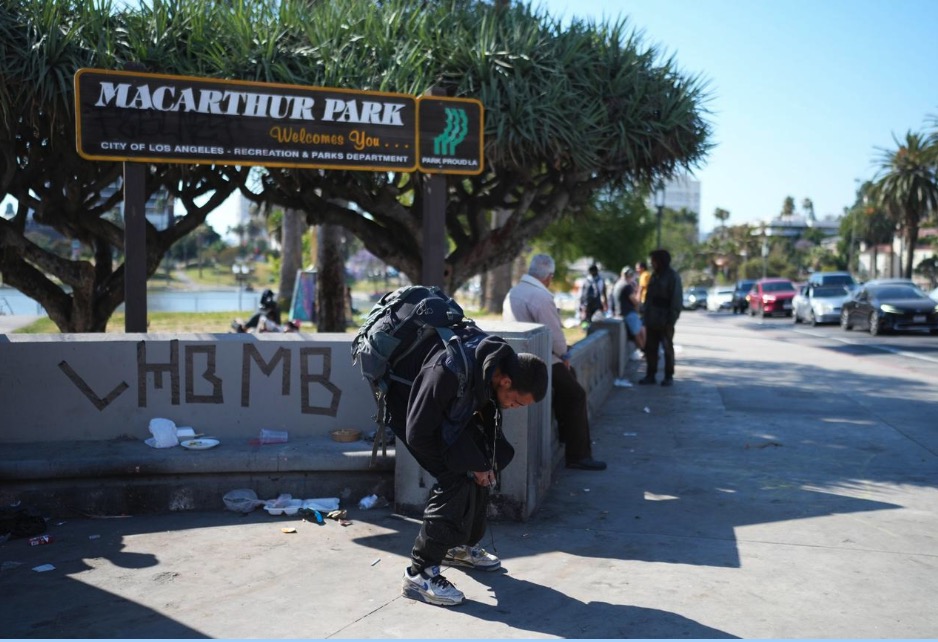
Bass eventually declared that MacArthur Park was no place for drug use, violence, or organized crime. That statement would be more impressive if her administration and the Council had not allowed those conditions to become internationally notorious before federal intervention.
Meanwhile, the city is planning tens of millions of dollars in physical improvements around MacArthur Park. Landscaping, lake restoration and stormwater work may be worthwhile, but capital improvements cannot substitute for sovereignty. A beautifully renovated park controlled by fentanyl dealers is not a public amenity. It is an expensive stage set for municipal surrender.
Lake Balboa represents the quieter phase of the same decline. It remains a valuable and heavily used recreational asset, with a lake, mature trees, playing areas and open space. But residents can see the effects of inadequate upkeep: deteriorating facilities, uneven landscaping, delayed repairs and a general impression that the city is consuming the park’s inherited value faster than it is restoring it.
The roads tell the same story. Los Angeles has increasingly relied on patches and so-called large asphalt repairs rather than comprehensive repaving, partly to avoid the expense and delay associated with accessibility upgrades triggered by full street alterations. That saves money today while allowing water to penetrate cracked pavement, undermine the roadbed, and multiply future reconstruction costs. (The Washington Post) This deterioration of the streets should reach a major crescendo with this winter’s Super El Niño scheduled to produce record rainfall.
The resulting liability is already substantial. Street-related litigation costs, including claims connected to potholes and other infrastructure conditions, reportedly increased from $13.9 million in fiscal year 2020–21 to $58.4 million in 2024–25.
Los Angeles is paying drivers for damage caused by roads it could not afford to maintain because it spent the money elsewhere—and will eventually pay again to reconstruct those same roads.
Its bridges are an even graver warning. The city maintains 516 bridges. More than 83% are over 50 years old, 24% have exceeded their original 75-year design life, and 8% received D or F sufficiency ratings. The city identified 51 priority bridges requiring repairs, yet its proposed strategy sought only $25 million over five years. (Rampla)
No responsible homeowner would treat a cracked foundation, corroding support beam or failing electrical system with such casual delay. City Hall does so because it loves addicts, hobos and street pushers more than taxpayers. Politicians pray that the failure will occur after several election cycles, allowing today’s politicians to take performative credit for social spending while leaving tomorrow’s taxpayers the repair bill.
Streetlights connect neglected maintenance directly to non-enforcement. By March 2026, Los Angeles had more than 32,000 outstanding streetlight service requests. Funding had remained essentially unchanged since 1996, while copper-wire theft increased 1,200% over a decade. Theft-related repairs can cost at least four times as much as ordinary maintenance. (Mayor Karen Bass) The city refuses to impose an immediate consequence on the thief, then imposes the accumulated financial consequence on every taxpayer.
Bass, Raman and the City Council have disperse responsibility among departments, regional agencies, nonprofit contractors, consultants and political committees until nobody can be held accountable for the final result.
When the water main bursts, the pipe is blamed. When the park becomes a drug bazaar, poverty is blamed. Drug addiction becomes a survival anti-rape strategy. When encampments burn, the housing shortage is blamed. When the lights go dark, copper thieves are blamed.
Los Angeles is not experiencing a series of unrelated emergencies. It is experiencing the compound consequences of a governing philosophy that considers enforcement cruel, maintenance optional, auditing adversarial and accountability politically dangerous. The infrastructure deterioration reflects a deliberate budget choice.
Karen Bass presides over that system. Nithya Raman helped design and finance major parts of it. The City Council repeatedly voted to sustain it. Either way, this November's dismal election will reinforce the current problems while leaving a vast opening for new, more tragic problems to arise.
(Eliot Cohen is a longtime civic advocate who has served on the Neighborhood Council, the Van Nuys Airport Citizens Advisory Council, and the Board of Homeowners of Encino, where he was president of HOME for over seven years. A retired Wall Street executive with a 35-year career, Eliot brings a sharp eye to local governance. He critiques the bureaucratic missteps of City, County, and State officials. Eliot and his wife split their time between Los Angeles and Baja Norte, Mexico.)