

Homelessness: The Numbers Just Don’t Work
iAUDIT! - This column contains a lot of numbers and some pretty arcane math, but its important we understand how the City uses questionable numbers to maintain the appearance of success. I believe local officials count on the difficulty in reconciling numbers to shroud how poorly homelessness programs perform.
In late 2024, the Mayor’s Office issued a press release that, among other things, claimed more than 23,000 people moved into temporary housing over the previous 12 months. This is an impressive number in light of the fact it represented about 52 percent of the 43.699 homeless people in LA, per LAHSA’s 2025 PIT count. Yet, according to the same PIT count, homelessness in the City declined by only 1,553 people compared to the 2024 count. This begs the question: how can the City could claim it sheltered more than half its unhoused population yet only reduced the homeless population by about 1,550 people? The answer to that question involves the nature of the homeless population, imprecise definitions, the data’s reliability, and political posturing.
First, there is a difference between being sheltered and being housed. In theory, 23,000 people could be sheltered, while a far smaller number would move into some type of permanent housing. According to most City-generated reports, shelter to housing transfers hover around 20 percent, so potentially, 4,600 (20 percent of 23,000) of those sheltered could have been housed in 2024. How would that affect the overall homeless population?
To answer that question, we need to remember the homeless population isn’t static. Every day, some people exit homelessness while others enter. A 2023 study by McKinsey & Co. estimated that, in LA County, 207 people exit homelessness but 227 fall into it. Therefore, the homeless population increases by 20 people per day, or 7,300 people per year. The City has about 62.5 percent of the County’s homeless population, so its annual increase is around 4,563 per year. To achieve a net reduction of 1,553, the City would have to house 6,116 people: 4,563 to negate the natural increase and another 1,553 to account for the overall decrease. Using the 4,600 housed number, at best the City would be able to keep the homeless population fairly static with no meaningful annual reduction.
So, how did the City achieve a net reduction of 1,553 people if its programs, house 20 percent of those sheltered? The short answer to that question is nobody--including the City--knows how many people have been sheltered or housed. As I’ve written many times before, the City does not count people--it counts processes. When it says it sheltered 23,000 people, in reality the City completed 23,000 sheltering processes for a smaller, but unknown number, of unique individuals. It may count the number of times it completed a shelter placement, but it has no idea if the person placed is new or has been in the system one or more times. This is neither a new nor isolated problem. A 2019 City Controller audit noted, “Repeated housing placements for the same person or family falling in and out of homelessness during a year are included in the [number of people sheltered] figure”. Six years later, nothing had improved. A 2025 study from the League of Women Voters of Greater LA stated, “…neither the city nor the county, which work together in many ways in their approaches to homelessness, consistently track the housing trajectories of people who enter the homeless services system, specifically how they are placed, then exited, then placed again repeatedly across a variety of shelter or housing types in a “churning” cycle of placement and displacement from one temporary accommodation to another”.
Although there is no way to know with certainty how many people are recycled through the shelter/housing system, we can estimate the number. In its May 2025 report to the federal court, audit firm Alavarez & Marsal found that 51 percent of participants in the city’s homelessness system were enrolled in more than one program, (page 117). The report says the percentage may include some people who progressed from one program to another, but it may also represent repeat clients, as the League of Women Voters report indicated. If we generously assume only 40 percent of the participants are repeat clients, that would be 11,730 of those 23,000 supposedly sheltered. That would leave 11,270 unique individual clients. If 20 percent of them were housed or otherwise exited homelessness, that would be 2,254, far less than the number needed to just keep the number of unhoused static. A certain number of repeat clients could also possibly be housed, but getting to the 6,116 people to achieve the purported reduction would be extraordinarily difficult.
We also need to remember the supposed reduction is based on LAHSA’s annual Point in Time (PIT) count, which has a long history of being based on unfounded assumptions and unreliable data collection practices. An October 2025 LAist article reported RAND analysts estimate LAHSA undercounts the homeless population by more than 30 percent, (or 7,900 people in the last count). The PIT count’s structural inaccuracy could be exacerbated by intentional manipulation. During hearings in federal court in May 2025, LAHSA’s former CIO Emily Vaughn Henry testified that homelessness data was “smoke and mirrors” designed to make Mayor Bass’ initiatives look good. During the same hearing, Alvarez & Marsal’s audit director said, “We do not believe, in the state that it [city programs] was in, that it could achieve a substantial and meaningful reduction in unsheltered homelessness in the city of Los Angeles.” So, whatever numbers the Mayor may use are tainted by inaccuracy and poor management oversight, if not outright dishonesty.
Compounding the uncertainty about homelessness numbers is the fact that at least six, and probably more, people die on LA’s streets every night. Although the LA County Department of Public Health touted the latest numbers from 2024 as evidence of success, the fact is that overdose is still the leading cause of death among the unhoused, followed by heart disease, which can be a result of chronic substance abuse. The number may be higher because it can miss people who die alone in subsidized housing; they are technically “housed” at the time of death and not counted among homeless deaths. I am not aware of any formal study looking at the effect of 2,208 annual deaths on the homeless population or PIT count, but it is probably significant.
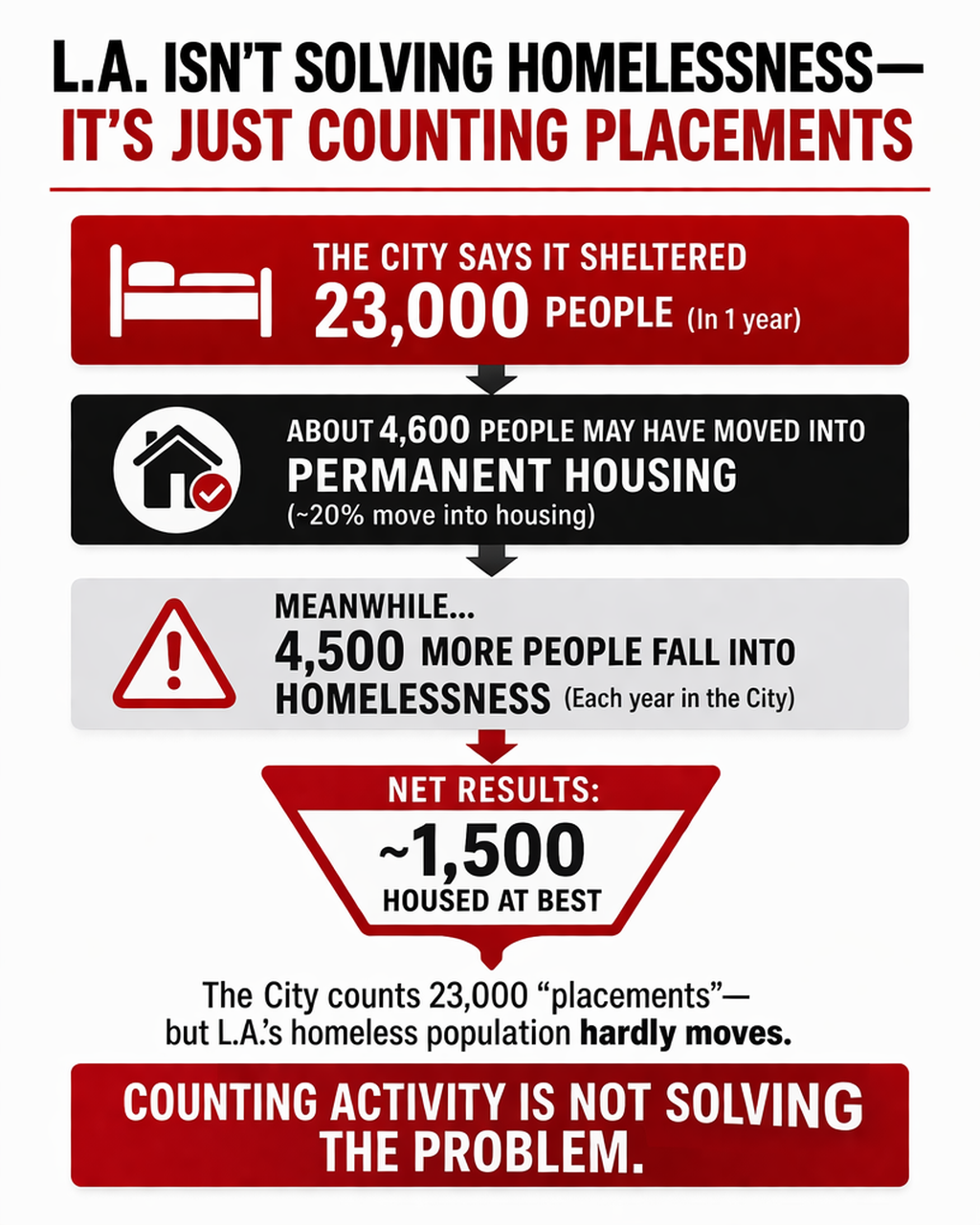
As the popular term goes, “The math aint mathing”. Despite sheltering 23,000 people and housing thousands, at best, homelessness in LA decreased by only 1,553 last year (if the PIT Count is to be believed). With a $1 billion homelessness budget, that means it costs $643,920 per person housed, and bear in mind many people who are housed fall back into homelessness. All of the numbers being thrown around come down to one fundamental question: if the City is doing such a great job sheltering and housing unprecedented numbers of people, why is homelessness still so pervasive? Between them, the City, County and LAHSA spend between $2 billion and $4 billion per year on homelessness. Shouldn’t we expect more impressive results for our money?
In the end, whatever numbers the City chooses to use, whether it claims 23,000 people were sheltered or 27,000 have been housed, the numbers cannot be trusted. There are simply too many opportunities for counting people two or more times, and a fixation on counting processes instead of people, not to mention mismanagement of data and possible fraud. Using unreliable numbers undermines any claim to progress the City makes, and sows distrust among an already skeptical public. We also don’t know what benefit, if any, we are getting for the $1 billion Los Angeles spends on homelessness. And most importantly, thousands of homeless people are left on the street where they receive no services and are offered no path to real assistance.
(Tim Campbell is a longtime Westchester resident and veteran public servant who spent his career managing a municipal performance audit program. Drawing on decades of experience in government accountability, he brings a results-driven approach to civic oversight. In his iAUDIT! column for CityWatchLA, Campbell emphasizes outcomes over bureaucratic process, offering readers clear-eyed analyses of how local programs perform—and where they fall short. His work advocates for greater transparency, efficiency, and effectiveness in Los Angeles government.)