

PLANNING WATCH - The Palisades and Eaton wildfires took place one year ago, and only a few homes have been rebuilt. We already know that climate change in Southern California has made wildfires more destructive. Over time this figure will undoubtedly increase, until the wildfires become a regular event.
A year after these record-setting fires, the following are undeniable:
- Hardly any homes have been rebuilt.
- Home and lot values have declined, even though they were rising before the wildfires. In LA’s Palisades neighborhood the value of destroyed homes declined from $14.7 billion to $10.8 between late 2024 to the second half of 2025. The decline in the Altadena area was similar, from $7 billion in late 2024 to $4.7 billion in the second half of 2025.
Despite this decline in home and land values, however, properties still had buyers, although they were largely corporate speculators.
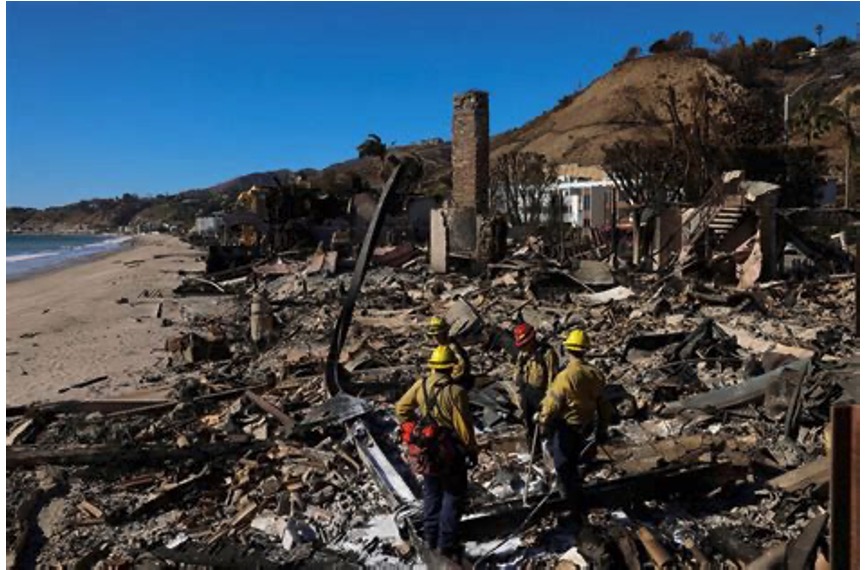
Many houses were totally destroyed in the Pacific Palisades and Malibu.
One year later LA’s Department of Building and Safety has only issued a few building permits, and the underlying parcels have experienced significant market decline (51.6 % in the Palisades and 51.3 % in Alta Dena, according to Realator.com). Realator.com attributes these declines to the cost and uncertainty of rebuilding.
How bad was the damage and how has rebuilding proceeded? According to CALFIRE, 40 percent of the homes in the two wildfire areas were either totally destroyed or seriously damaged. Altogether an estimated 100,000 local residents were displaced. While the debris from the two wildfires was quickly removed, reconstruction of homes has hardly taken place. Malibu alone saw 600 homes incinerated by the wildfire, and only 22 building permits have been issued. In Altadena,1,100 permits have been granted, but construction has only been completed for four single-family homes, one apartment house, and three accessory dwelling units. In LA,1,740 construction plans have been approved, but only 417 projects have begun construction, and only two projects have been completed. They included a showcase home built by a developer, not by a homeowner.
What are the lessons from these fires? Even under ideal conditions, such as this year’s heavy rains, hillside areas remain dangerous. It only takes two weeks for neighborhoods to sufficiently dry out for wildfires to start. While the mainstream media predictably blames arsonists, the real cause is the natural setting. This is why urban historian Mike Davis argued that these fire-prone areas should not be opened up for housing. The real culprits are the developers and the politicians who enable them to (re)build in these extremely dangerous areas.
According to Davis, in his 1998 essay, The Case for Letting Malibu Burn:
“The rugged 22-mile-long coastline is scourged, on the average, by a large fire (one thousand acres plus) every two and a half years. . . At least once a decade a blaze in the chaparral grows into a terrifying firestorm consuming hundreds of homes in an inexorable advance across the mountains to the sea. Since 1970 five such holocausts have destroyed more than one thousand luxury residences and inflicted more than $1 billion in property damage. Some unhappy homeowners have been burnt out twice in a generation, and there are individual patches of coastline or mountain, especially between Point Dume and Tuna Canyon, that have been incinerated as many as eight times since 1930.”
The difference between 1998, when Davis wrote his essay, and today is the role of climate change. Current wildfires are not only 35% worse, but more frequent. Davis’s admonition to let Malibu burn makes even more sense now that it did when he wrote it.
The chance that his advice will be followed is unlikely, but the increasing cost of insurance and rebuilding may eventually lead to the same result. Fire-prone areas should remain off-limits to developers.
(Dick Platkin ([email protected]) is a retired LA city planner. He reports on local planning issues and serves on the board of United Neighborhoods for Los Angeles. Previous columns are available at the CityWatchLA archives.)