BUDGET ADVOCATES -
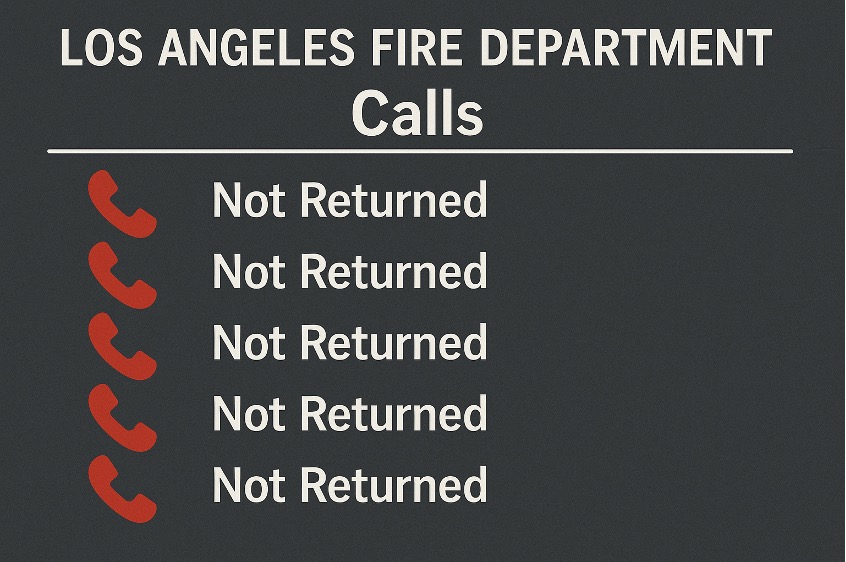
Call the Los Angeles Fire Department.
No response.
And no, this isn’t about a 911 call. This is about something far less dramatic on the surface — but far more dangerous for Los Angeles in the long run. For the second year in a row, the Neighborhood Council Budget Advocates have been trying to meet with the Los Angeles Fire Department’s administration to review and discuss their upcoming budget request. As co-chair of the Budget Advocates, I have personally placed at least a dozen calls to LAFD leadership and budget staff. Not a single one has been returned.
A Department Asking for Billions — But Not Answering Questions
LAFD is preparing to request major, multi-year funding increases, including a bond measure or tax increase, funding to build 60 new fire stations, and the hiring of thousands of additional firefighters and paramedics to address severe staffing shortages. Today, LAFD runs with roughly 3,500 sworn personnel, a number far below what a modern city of 4 million requires — especially when call volume has climbed to more than 1.4 million emergency responses annually, a nearly 30% increase over the last decade.
These upgrades are critically needed — no one disputes that. But when a department asks voters to support new taxes and long-term financing that could total $5–7 billion over the next 20 years, residents deserve transparency. This expectation becomes even more urgent after high-profile incidents like the Palisades Fire, which burned 1,200 acres, forced evacuations, and raised serious questions about staffing, readiness, and response capacity.
A department seeking billions should not be avoiding basic oversight conversations.
Silence Isn’t Just Bad Optics — It’s Bad Governance
If anything illustrates the urgency of LAFD’s internal challenges, it’s this: a department facing a staffing crisis, an infrastructure crisis, and a growing public trust problem is not communicating with its own budget oversight representatives. That’s not just frustrating — it’s unacceptable.
LAFD’s facilities crisis is well documented. The average fire station in Los Angeles is now over 50 years old, with some approaching 70 years. Many lack modern HVAC systems, gender accommodations, seismic safety upgrades, and cancer-mitigation equipment — issues that can cost millions per station to correct.
Government only works when departments are willing to engage openly with the public and with the bodies charged to hold them accountable. When communication breaks down, so does oversight — and the city pays the price.
This is especially concerning because LAFD’s capital and staffing expansions could ultimately cost billions of taxpayer dollars over multiple decades, yet the department has not provided the most basic explanations or projections to those charged with reviewing the numbers.
The City Has Grown — The Department Has Not
Los Angeles is a city that now swells to nearly 4 million residents on any given day — and LAFD’s workload reflects it. Call volumes have increased by over 70% since the early 2000s, while the number of active fire stations has barely changed. Meanwhile:
- Response times in some neighborhoods now exceed 7–8 minutes, well above national standards.
- Fire engines and ambulances often run back-to-back calls for entire shifts.
- Many stations report persistent vacancies, requiring overtime that costs taxpayers hundreds of millions annually.
Everyone agrees LAFD needs significant upgrades. But those upgrades must be informed by oversight, transparency, and public discussion — not by silence.
This communication gap is not new, either. While many departments routinely meet with the Budget Advocates, LAFD’s absence has become a multi-year pattern that erodes trust and weakens the city’s budget process.
A Call for Immediate Engagement
LAFD leadership should read this article and call the Budget Advocates now — not next month, not next year, and certainly not after the next catastrophic fire.
We are ready to collaborate.
We are ready to listen.
But the department must be willing to talk.
Los Angeles deserves a fire department equipped for the city it has become — not the city it used to be. And the first step toward that future is simple:
Return the call.
(Jay Handal is a veteran community advocate and contributor to CityWatch. He serves as co-chair of the Neighborhood Council Budget Advocates and treasurer of the West LA-Sawtelle Neighborhood Council. With years of grassroots organizing and civic engagement, Jay is a leading voice for transparency, budget reform, and community empowerment in Los Angeles.)