

Open Letter to Gov. Newsom: I Am the Blue Dot
Dear Governor Newsom,
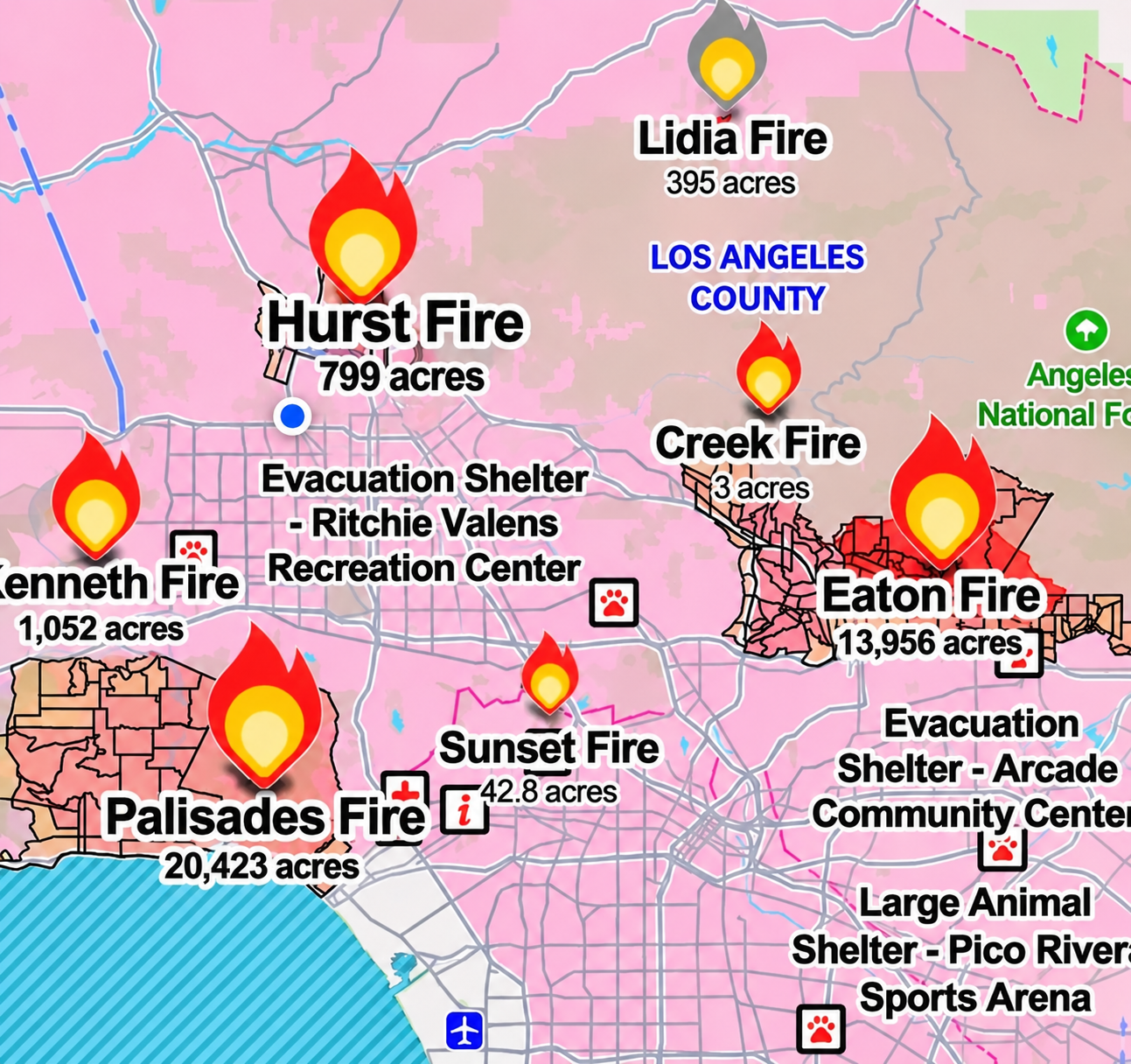
As you prepare to leave office, I want to tell you about a little blue dot on a map.
That blue dot is my home in the northwest San Fernando Valley. In January 2025, as wildfires erupted across Southern California, I watched fires burn in multiple directions around my community. My electricity was out for approximately 108 hours. On another occasion, I waited 25 minutes for someone to answer my call to 911.
We live in a valley surrounded by mountains and hillsides, where Santa Ana winds can turn a brush fire into a catastrophe with terrifying speed. We live in an earthquake-prone region that experienced the devastating 1994 Northridge earthquake. Our evacuation routes are constrained, our infrastructure is aging, and when the fires are extinguished, heavy rainfall can send mud and debris cascading down burned hillsides.
Yet your administration and the Legislature have accelerated housing approvals without, in my view, adequately protecting communities facing precisely these conditions.
Facts are stubborn things, Governor.
On May 14, 2025, you announced your intention to accelerate housing development with a message that was unmistakable: “We're done with barriers. Let's get this built.”
On June 30, you signed AB 130 and SB 131, bringing significant changes to California's housing and environmental-review laws.
Well, Governor, some of those so-called “barriers” were actually protections. Protections intended to safeguard lives, property, and entire communities.
And that is what you failed to consider in your equation.
You were determined to remove the obstacles. But did you stop to distinguish between unnecessary bureaucratic delays and safeguards designed to protect people living in geographically vulnerable communities?
You and the Legislature have given Californians plenty of reasons to become familiar with a rather remarkable little word: ministerial. It sounds harmless enough. Almost administrative. But under qualifying housing laws, it can mean that a home next door is demolished and replaced with a substantially larger multifamily building without the discretionary public hearing at which residents might otherwise raise concerns about evacuation, parking, infrastructure, or cumulative neighborhood impacts.
You have supported laws that remove opportunities for residents to ask city planners to do what they are supposed to do: examine whether a proposed development belongs where someone wants to put it.
That is not bureaucratic interference. That is their job.
And let's not pretend these projects are necessarily confined to carefully designated areas where roads, utilities, and emergency services have been evaluated for additional density. Depending on the applicable law and zoning, qualifying developments can appear throughout established residential neighborhoods.
Then there's parking. Certain housing laws allow reduced parking requirements or no required on-site parking at all.
Brilliant, Governor.
Here in the San Fernando Valley, narrow, winding residential streets already present challenges for emergency access. Add more residents, visitors, service vehicles, and cars competing for curb space, and then explain how a fire engine or ambulance is supposed to get through when every second matters.
Better yet, explain how residents are supposed to evacuate while emergency vehicles are trying to enter.
Consider the proposed 71-unit assisted-living development on Del Moreno Drive in Woodland Hills, with no on-site parking. Where are employees, visitors, and service providers supposed to park? And what happens when those vehicles compete for space on streets that emergency responders may need?
These are questions of public safety, not simply neighborhood preference.
Ministerial approval does not eliminate building and fire codes. But compliance with individual project requirements is not the same as evaluating the cumulative consequences of adding substantial density to neighborhoods with limited evacuation capacity.
You can streamline a permit, Governor. You cannot streamline a wildfire.
And this is hardly a concern unique to the San Fernando Valley.
Ask the residents of Paradise, Concow, and Magalia, where the 2018 Camp Fire killed 85 people and evacuation routes became overwhelmed. Ask the communities around Santa Rosa that experienced the 2017 firestorm. Or consider Topanga and Malibu, where wildfire exposure, hillside geography, and limited road access create their own extraordinary challenges.
California has no shortage of communities where geography should matter enormously to land-use decisions. Yet where were the meaningful carve-outs for vulnerable neighborhoods? Where were the requirements to demonstrate that evacuation routes and emergency services could accommodate the cumulative consequences of additional development?
And where were our elected representatives?
I am speaking specifically about Senator Henry Stern and Assemblymember Pilar Schiavo, whose constituents include communities in the northwest San Fernando Valley.
At a Northridge neighborhood meeting concerning these policies, neither attended. Staff representatives appeared instead. Despite weeks of advance notice, they were, in my assessment, unprepared to answer basic questions and repeatedly referred to their preference for rescheduling the meeting.
Residents came expecting explanations. We left with more questions.
I have a recording of that meeting.
Constituents should not have to become land-use attorneys and emergency planners simply to determine whether their neighborhoods are being placed at greater risk. Our representatives should be asking these questions before legislation becomes law.
There is another distinction your administration has blurred: a housing affordability crisis is not necessarily the same as a shortage of available homes in every community.
My own review of Multiple Listing Service listings revealed properties available throughout the San Fernando Valley. That is not a comprehensive housing study, nor does it establish sufficient supply at affordable prices. But it illustrates why local inventory and affordability deserve closer examination before statewide assumptions are used to justify overriding neighborhood planning.
Meanwhile, existing homeowners face rising insurance premiums, utility costs, and foreclosure pressures.
What good is adding housing if the people already living here cannot afford to keep their homes—or cannot depend on the infrastructure and emergency services necessary to live in them safely?
I understand California needs housing. I also understand that some local governments have used planning requirements to obstruct needed development. But removing unreasonable barriers should not mean eliminating opportunities to identify genuine public-safety risks.
There were other ways to encourage construction: incentives for development where infrastructure can support it, redevelopment of suitable commercial properties, housing preservation, and meaningful evacuation analysis before—not after—substantial density is approved.
Instead, established neighborhoods have too often been left to absorb the consequences of decisions made without adequately examining their capacity to do so.
Governor, you have managed to do something I never imagined possible: take someone who supported you and utterly crush that support. Not because of political ideology, but because your policies have placed the future of communities like mine in question. And I am not simply talking about property values or the character of our neighborhoods, although those matter enormously. I am talking about something far more fundamental: our lives and our safety.
And shame on our elected representatives, particularly Senator Henry Stern and Assemblymember Pilar Schiavo, for failing, in my view, to secure meaningful protections for geographically vulnerable communities as these sweeping housing laws moved through Sacramento. Where were the demands for carve-outs for neighborhoods facing extraordinary wildfire risks, constrained evacuation routes, and aging infrastructure? If protecting the lives of your constituents wasn't worth fighting for, what exactly was?
Shame on you, Governor, for leaving us this way.
To California's Next Governor
Whether California's next governor is Xavier Becerra, Steve Hilton, or someone else, I am calling on you to make this your first order of business:
Seek an immediate pause on expedited, ministerial housing approvals in the San Fernando Valley and other communities with documented extraordinary wildfire, seismic, evacuation, or infrastructure risks, pending a comprehensive review of public-safety safeguards.
Work with the Legislature to establish enforceable geographic exceptions where necessary. Require meaningful cumulative evacuation analysis, verification of emergency access and infrastructure capacity, and opportunities for public hearings when serious safety concerns arise.
Paradise should have taught California something about the consequences of evacuation failures. The January 2025 Los Angeles fires should have reinforced that lesson.
I am not asking you to stop building housing. I am asking you to stop treating every parcel in California as though it presents the same risks. If changing these laws requires legislative action, make that legislation an immediate priority.
Governor Newsom, before you leave office, look at that photograph of the January 2025 fires.
Find the blue dot.
Imagine your family living there, the electricity out for days, the winds howling, fires burning in multiple directions, and the roads potentially becoming impassable just when you need them most.
Now imagine being told that your neighborhood must accommodate substantially more development while nobody can demonstrate that the roads, utilities, and emergency services can safely accommodate the population already there.
Would you still consider those concerns obstacles to be streamlined away?
Perhaps you would see things differently if the blue dot represented your home and your family.
But it doesn't, Governor.
So before you decide that we need even more density here in the San Fernando Valley, which has long been treated like the redheaded stepchild of Los Angeles, consider this:
I am the blue dot. And I came first.
(Eva Amar is a West San Fernando Valley community organizer, contributor to CityWatch Los Angeles, and National Sexual Assault Victims Advocate.)