

Errors Of Commission Or Omission?
PLANNING WATCH - Before they became colored parcels on a City Planning map, they were neighborhoods. They were people’s homes. Homes that ordinary middle-class families worked a lifetime to afford. Now Sacramento’s housing legislation and Los Angeles City Planning are rewriting the rules governing those neighborhoods. The zoning those families relied upon was never guaranteed.
Sacramento’s All-You-Can-Build Legislative Buffet
California lawmakers have assembled quite a menu. SB 9 permits additional homes and lot splits on qualifying single-family properties. SB 684 streamlines certain small subdivisions. SB 1123 extends development opportunities to qualifying vacant parcels, while AB 130 provides environmental-review exemptions for eligible housing projects.
But apparently Sacramento’s all-you-can-build legislative buffet wasn’t enough. Los Angeles City Planning went back for seconds. Enter Missing Middle LA, a proposed ordinance expanding development opportunities in established residential neighborhoods. Maria Pavlou Kalban of United Neighbors put it succinctly: “The Missing Middle Ordinance is missing ‘community’.”
Starter Home. Starter Price Not Included.
I’ve always believed it’s the lack of money that’s the root of most evil. When everybody’s flush, things generally go more smoothly. Government isn’t so different.
As insurance, financing, materials and labor costs rise, large developments become harder to finance. Smaller projects offer another path, and City Planning has found a way to build them in neighborhoods that are already developed.
The streets, sewer lines and electrical infrastructure are already there, whether or not they can handle the added demand. There’s just one pesky little obstacle: the single-family house already sitting there. Apparently, City Planning has found a way around that, too. They’re calling it Missing Middle.
Our review of publicly advertised listings and market reports identified thousands of homes for sale and available rentals in the San Fernando Valley. There’s no shortage of housing here if you’ve got money. Sacramento keeps conflating an affordability crisis with a housing shortage. And I don’t believe for one minute our legislators don’t know the difference.
In Granada Hills, apartments barely 500 square feet have been advertised for about $2,500 a month; larger units approach $4,000. Solaterra Granada Hills has advertised townhomes approaching $5,300. We are not talking about Beverly Hills. We are talking about Granada Hills.
Errors Of Omission: Planning Without Los Angeles
Under Mayor Eric Garcetti, Los Angeles launched its Low-Rise Design Challenge and subsequent Design Lab, with approximately $1,565,165 in identified financial commitments for the Design Lab and related zoning work. What did taxpayers get? A housing approach already being tried elsewhere. For originality, an F. But the greater omission is what City Planning’s approach appears to have overlooked: Los Angeles itself.
Los Angeles isn’t Portland, Austin or Chicago. We have earthquake faults, wildfire corridors, unstable hillsides and Santa Ana winds. Our neighborhoods empty onto crowded roads and a few critical passes: the 405 through Sepulveda, the 101 through Cahuenga and Interstate 5 through Newhall.
In the Missing Middle materials I’ve reviewed, I have not found a comprehensive assessment of how cumulative neighborhood density could affect evacuations during earthquakes, wildfires, mudslides or landslides. They found room for more housing units. But where was the room for disaster planning?
I live in the San Fernando Valley, where I could see the Pacific Palisades burn. I watched it. Now even a small plume of smoke brings real fear. Neighborhood messaging groups light up: Where is it? How fast is it moving? Do I need to pack my car?
We lived through the Northridge earthquake, watched the Palisades and Eaton fires, and know that 85 people died in the 2018 Camp Fire in Paradise. In a proposed Granada Hills corridor involving approximately 190 identified parcels, how many additional vehicles might need to escape during the next emergency?
Granada Hills, Northridge, Porter Ranch and other northwest San Fernando Valley neighborhoods have already shouldered more than their share of Los Angeles’s environmental burdens. Residents have lived alongside landfills and gas infrastructure, including the Aliso Canyon storage facility, site of the catastrophic 2015 methane leak, one of the largest in American history.
Apparently, having served as Los Angeles’s backyard for decades, the northwest Valley is now expected to surrender its front yards as well.
Before approving more density, City Planning should demonstrate that sewer, water, power, streets and emergency routes can handle its cumulative effects. Approving one project is a development decision. Understanding what happens when it is repeated across a neighborhood is planning. For planning, another F.
Errors of Commission: Six Yes Votes
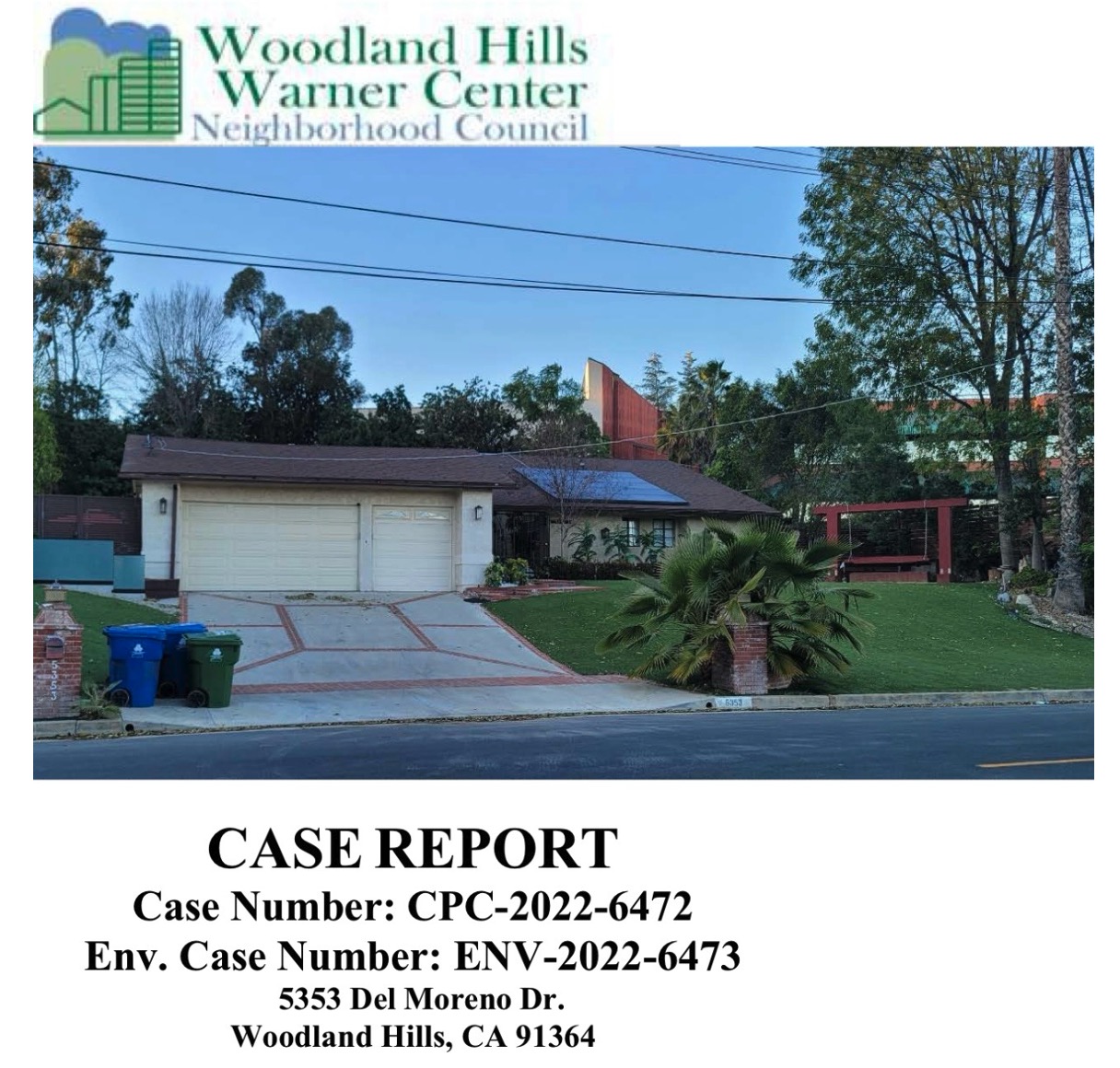
Consider 5353 North Del Moreno Drive in Woodland Hills. An earlier apartment proposal was rejected by the City. Litigation followed, involving YIMBY Law. The developer sought $486,053.50 in attorney fees; the City Attorney’s Office subsequently recommended $241,080.50.
Then the same developer returned to the same parcel with a very different proposal: a three-story, 71-room residential-care facility for the elderly, with no automobile parking. More than 600 residents signed a petition opposing it.
At the August 27, 2026, City Planning Commission hearing, commissioners questioned the project’s suitability. Commission President Monique Lawshe called it “too big for the location.” Then they approved it. Six commissioners. Six yes votes.
I subsequently questioned Councilmember Bob Blumenfield, whose district includes the property. His responses, provided through his communications deputy, were revealing.
I asked whether he believed a 71-room assisted-living facility with no on-site parking, across from Taft Charter High School, was appropriate for that location. His answer? “No.” He elaborated: “I don’t think this low density single family neighborhood is where a multi-family 3 story structure should go without the City’s normal analysis and review.”
I asked whether the commission lacked meaningful discretion to deny or substantially modify the project. Blumenfield acknowledged: “While the CPC has some theoretical discretion, the legal threshold to deny the project is very high and hard to meet.” He described the number of requested development waivers as “ridiculously high.”
And when I asked whether his office had submitted a written position or otherwise advocated against the revised proposal before the commission, his answer was: “No, but my position is well known and a matter of public record.”
Although Councilmember Bob Blumenfield opposed the project, his office submitted no written opposition to the commission. A staff member arrived at the hearing after public comment had closed. The residents were left to make their case without their elected representative’s opposition being presented to the commissioners.
This was a discretionary decision, albeit one constrained by state housing law. How would a 71-room care facility function without automobile parking for staff, visitors and services? How would residents, some potentially unable to evacuate on their own, be moved to safety?
I can’t tell you whether the earlier lawsuit influenced the vote. But when commissioners question a project’s suitability, the district’s councilmember agrees it doesn’t belong there, and the project receives unanimous approval anyway, what exactly is their oversight accomplishing?
My five-year review of publicly available records identified just one City Planning Commission decision rejecting an underlying development and none by the North Valley Area Planning Commission. It was not a complete audit. It was enough to make me question how often these bodies actually say no.
And To Top It All Off: The Price Of An Appeal
City Planning has proposed raising certain planning-appeal fees. The City Council’s Planning and Land Use Management Committee voted 5–0 to advance the proposal.
Fees currently set at $229 could rise to $1,145 for certain nearby residents or $2,289 for those outside the notification area—five times the price, and in some cases ten.
Perhaps City Planning doesn’t want those volunteer commissioners working too hard. Developers have attorneys. Homeowners have mortgages, property taxes and, apparently, an increasingly expensive admission ticket to City Hall. And their taxes help pay for the planning initiatives they’re fighting.
If you're counting on City Planning, the appeal process, your Assembly members or your City Council members to protect the neighborhood you worked a lifetime to live in, consider everything you've just read.
Help is not on the way.
Errors of commission or omission?
Both.
And in Los Angeles, those errors could cost the City and State millions in liability.
And as we've already seen, they can cost lives too.
(Eva Amar is a West San Fernando Valley community organizer, contributor to CityWatch Los Angeles, and National Sexual Assault Victims Advocate.)