
Thousands Of Vacant Units In LA, Yet Developers Claim There Is A Housing Shortage
PLANNING WATCH - In Los Angeles most neighborhoods have vacant units. Most are apartments, but some, like in the photo above, are houses. At the same time, LA’s neighborhoods also suffer from homelessness and overcrowding. There are three explanations for this deplorable situation.
Explanation 1: The LA region is filled with people who cannot afford to rent or buy vacant units. This is why they are homeless or overcrowded.
Explanation 2: Homeless and overcrowded people know what type of housing they want. If it is not exactly available, then they decide to sleep outside or live in overcrowded conditions.
Explanation 3: In a third of cases, homeless and overcrowding results from mental illness and/or drug addiction. According to a recent UCSF study, this explanation applies to a temporary minority, but then the next question arises, why are so few being actively treated?
Those who have read my previous columns, know I believe Explanation 1 is correct, the second is nonsense, and the third only temporarily applies to a small minority.
After all, who would voluntarily choose to be homeless or live in overcrowded conditions if they could afford a vacant apartment or house. Even though the mass media treat Explanations 2 and 3 as best, they only temporarily apply to about 1/3 of the homeless and totally ignore the overcrowded.
Nevertheless, the housing “experts” insist that the second and third explanations are the correct ones. They never concede that poverty is the main explanation for LA’s record homelessness and overcrowding.
Since it is s lack of money, not discriminating taste or addiction, that accounts for most of LA’s record homelessness and overcrowding, why is it that the mass media, public officials, and “housing experts” stick to the second and third explanations?
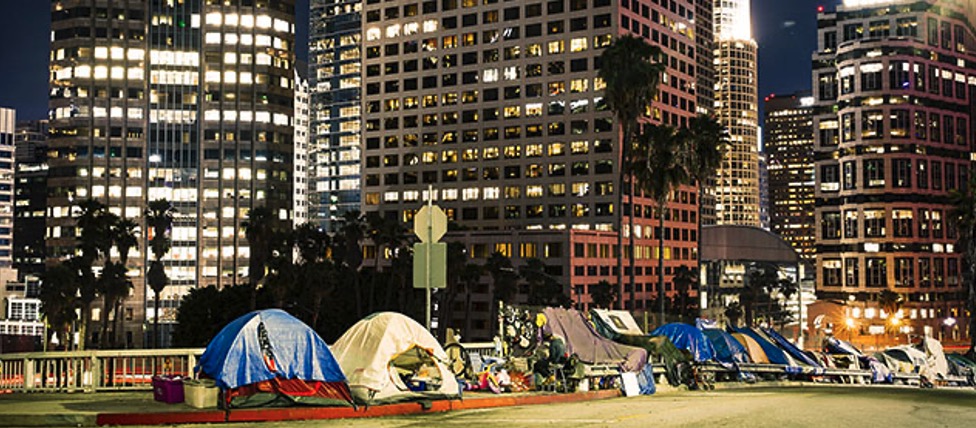 Tents of homeless people in downtown Los Angeles
These are my explanations:
- Contractors are in the business of building private housing, and the poor, whether homeless or living in overcrowded conditions, can’t afford the housing that developers can profitably build.
- The housing the poor could theoretically afford is based on HUD housing programs cancelled a half century ago. While local public housing agencies still exist, they only offer legacy public housing built in the 1960s or earlier.
- Nearly all of those with severe mental illness or addiction already have a place to live despite their conditions.
Where do we go from here? There are still two theoretical options available to cities and counties which want to provide subsidized, low-priced housing to low-income residents who cannot afford a place to live.
First, cities can spend the own money on subsidized housing for those who are too poor to rent or buy this housing. Unfortunately, few local governments have the financial resources for this option.
Second, cities can give a housing subsidy directly to qualified low income individuals or families. Of course, this option, too, relies on available funds, which means few municipalities can offer this option.
As a result, the situation of those priced out of housing is not good, and for the past 50 years the ranks of the homeless and pvercrowded have increased. At his point, the LA region has over 77,000 homeless people and 1,000,000 living in overcrowded conditions. Furthermore, these numbers will dramatically increase when the next recession/depression soon kicks in.
I wish I could be more optimistic, but without mass political opposition little will improve.
(Dick Platkin is a retired Los Angeles city planner who writes about planning issues in LA. He is a member of United Neighborhoods for Los Angeles (UN4LA). Previous columns are available at the CityWatchLA archives.)