
Bulldozers, Bureaucrats, and Blowhards
OP|ED - You Think You Know What Fire Is?
We know the smell of smoke. The red glow over a ridge. The helicopters overhead. The evacuation warning that suddenly becomes an order.
We know what it means to look at a road and wonder whether everyone can get out.
But there is another F.I.R.E. burning in California.
In economics, F.I.R.E. stands for Finance, Insurance and Real Estate. And Sacramento keeps feeding it.
In May 2025, while unveiling proposals to streamline permitting and accelerate housing and economic development, Governor Gavin Newsom explained the philosophy rather plainly:
“The Golden State was built on boldness and innovation, not red tape — we can’t continue to block our own economic success. We’re done with barriers. Let’s get this built.”
Economic success. Those are the Governor’s words.
Construction creates an asset once. Real estate can generate economic activity from that asset for decades through sales, financing, rents, insurance, management and transactions. Construction feeds FIRE.
Nothing is inherently wrong with economic activity. The question is what California is willing to sacrifice to generate it.
Because some of those “barriers” Sacramento has been dismantling were things Californians thought were protections: zoning, environmental review, parking requirements, community plans, public hearings and local discretion.
You called them barriers. Some of us called them guardrails.
And people are not supposed to be kindling for the economy.
Los Angeles unquestionably has an affordable-housing crisis. But drive around and you’ll see something else: NOW LEASING.
At Solaterra Granada Hills, three-bedroom rents have started above $4,300 a month, with four-bedrooms approaching $5,000. California can streamline approvals, override zoning and eliminate parking requirements until Sacramento runs out of bills to pass. But building another $4,000-a-month apartment doesn’t make a $4,000-a-month apartment affordable.
So before we bulldoze another community plan in the name of an affordable-housing crisis, answer the most obvious question first: Affordable to whom?
But the cost of feeding one F.I.R.E. isn’t measured only in dollars.
Because then there is another “barrier”: environmental review.
I come from Chicago. We worried about plenty of things, but not Santa Ana winds driving wildfires toward neighborhoods sharing the same evacuation routes.
This is California.
The California Environmental Quality Act — CEQA — wasn’t created because somebody in Sacramento thought developers needed more paperwork. It requires government to look before it leaps: identify significant environmental effects, disclose them to the public and, when feasible, mitigate them.
That isn’t an inconvenience. It’s a protection.
Sometimes the environment is telling you something. Sometimes the road really is too narrow. Sometimes the habitat really is there.
Yet somewhere along the way, CEQA began being portrayed not as a safeguard but as an obstacle — another barrier, another piece of red tape, another nuisance. Like a little gnat that landed on the fruit: annoying, inconvenient, something to flick away.
Never mind why CEQA was there in the first place. Never mind that this is California.
Just flick it away and build.
And if residents object, there is another convenient way to flick them away. Call them NIMBYs.
What about evacuation? NIMBY. Wildlife habitat? NIMBY. Emergency access? NIMBY.
When did NIMBY become a substitute for CEQA?
Ask the residents fighting the proposed development at the Woodland Hills Country Club.
A developer proposed 398 residences on the property in a Very High Fire Hazard Severity Zone. Residents questioned whether 398 new residences should be placed on this particular property and what that could mean for surrounding neighborhoods, including narrow, winding roads that can become evacuation routes during a wildfire.
These aren’t theoretical concerns. In 2018, the Camp Fire virtually destroyed Paradise. Eighty-five people died. In January 2025, the Eaton Fire devastated Altadena. More than 9,400 structures were destroyed and 17 people died. That same month the Palisades Fire tore through Pacific Palisades and into Malibu. Woodland Hills residents experienced evacuation orders and warnings.
Then came Pod Save America.
During an interview with gubernatorial candidate Steve Hilton, host Jon Lovett described Woodland Hills residents as suing to stop housing because the golf course “might be” habitat for mountain lions. Then he dismissed their position with one word:
“Bullshit.”
Really? Bullshit for what?
For asking whether this particular property can safely accommodate 398 residences? For expecting the City to examine the evidence?
There’s another problem. The residents hadn’t sued to stop the project.
The developer sought ministerial fast-track approval. Los Angeles City Planning ultimately determined that the project was ineligible for that ministerial processing after finding substantial evidence concerning protected-species habitat. The mountain lions weren’t something residents invented because they didn’t want apartments nearby.
Mountain lions in Woodland Hills aren’t hypothetical. In July 2022, the National Park Service documented the death of P-89, a two-year-old male mountain lion struck by a vehicle on the 101 Freeway between the DeSoto and Winnetka exits — roughly two miles northeast of the Country Club property.
The environmental evidence did exactly what scrutiny is supposed to do: it uncovered a fact that mattered.
Yet somehow the residents raising that evidence became the villains.
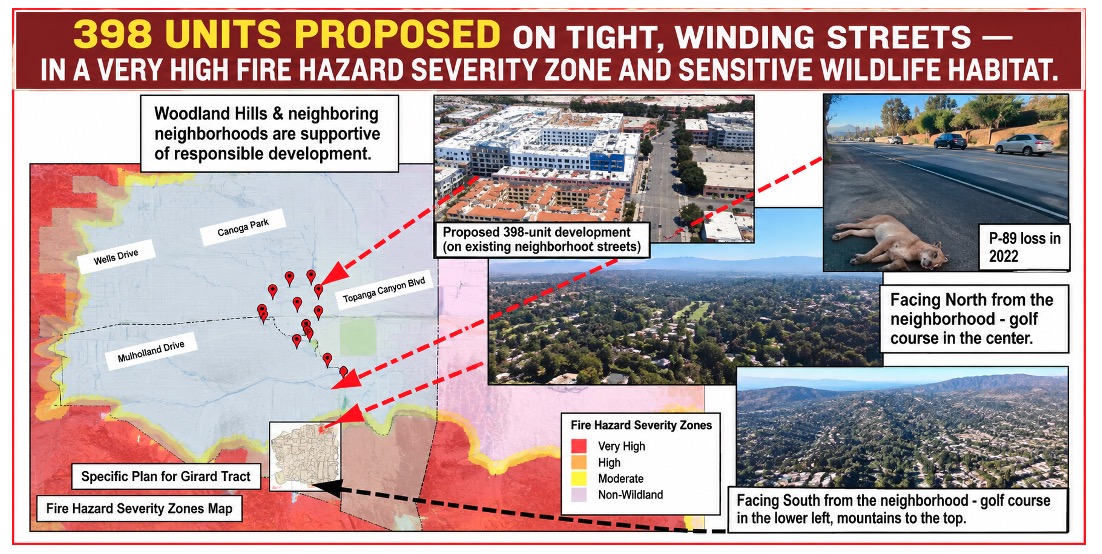
Allison Charalambous, community engagement lead for the Woodland Hills Neighborhood Collective, put the community’s position more plainly: “All the community has ever asked for is a full environmental and public review under CEQA of a 398-unit high-density development within a VHFHSZ on a functional mountain lion habitat, not an unvetted, streamlined shortcut.”
That is what happens when NIMBY becomes a substitute for CEQA. You don’t have to examine the evidence. You just discredit the people asking.
I watched the Palisades Fire from across the Valley, without power, for four and a half days. I remember the smoke, the sky, and what fire can do when wind, terrain and vegetation align.
So I’ll turn Jon Lovett’s dismissal around.
What’s bullshit about asking whether people can get out? What’s bullshit about asking government to determine whether the habitat exists before removing the very process designed to examine it?
Paradise burned. Altadena burned. Pacific Palisades burned. Malibu burned. And Woodland Hills evacuated.
Those aren’t NIMBY talking points. Those are warnings written in fire.
Fire doesn’t care whether Sacramento calls environmental review a barrier. It doesn’t care whether somebody calls you a NIMBY. And it certainly doesn’t care whether a podcast host calls your concerns bullshit.
Fire only cares about what is there when it arrives: the terrain, the vegetation, the wind, the houses, the people.
And the road out.
Here’s the irony. California government hasn’t forgotten how to say no. It just seems to have changed who gets to hear it.
In Woodland Hills, residents asking for scrutiny of the Country Club project get dismissed as NIMBYs.
Not far away, residents fighting Del Moreno face a proposed 71-room eldercare facility with zero automobile parking, across from a high school, in a location raising serious fire and evacuation concerns. The project got yes. The residents got no.
That “Yes” has a legislative history. Assemblymember Christopher Ward authored AB 2694, sponsored by LeadingAge California, which helped bring qualifying RCFEs within California’s housing-development framework. LeadingAge California’s PAC also contributed $11,400 to Ward campaign committees in 2024 and 2025. The contribution does not establish that it influenced the legislation. But taxpayers are entitled to know who helped write the rules, who supported them and who benefits from them.
In Granada Hills, residents have spent years questioning a proposed 98-unit MorningStar eldercare facility in a Very High Fire Hazard Severity Zone near a constrained evacuation route. Again, the community keeps asking government to look. And government keeps looking for a way to build.
Different projects. Different laws. Same message.
Sacramento has become extraordinarily good at saying yes to development. It seems to have forgotten how to say yes to the people who already live here.
Governor Newsom said California was “done with barriers.” Governor, look again at what some of those barriers actually are: environmental review, community plans, evacuation questions and public participation.
Not every regulation is sacred. CEQA can be abused. California needs housing. Fix what’s broken. But don’t confuse the guardrail with the obstruction.
Before California dismantles another safeguard in the name of solving its housing crisis, pause long enough to find out whether the laws already passed are actually solving it.
Are they producing housing the people priced out of California can afford? Are we measuring infrastructure before adding density? Are we examining evacuation before adding hundreds of households to a fire zone?
If the answer is yes, publish the numbers. I’ll print them. If the answer is no, stop calling the people asking these questions the problem.
One F.I.R.E. is measured in dollars. The other fire can be measured in lives.
You don’t strengthen an economy by treating the people who built it as fuel.
The people who make these decisions can move on. The people who live here are left with the consequences of decisions they did not make.
(Eva Amar is a West San Fernando Valley community organizer, contributor to CityWatch Los Angeles, and National Sexual Assault Victims Advocate.)