
Will LA’s METRO Ever Build Successful Mass Transit
PLANNING WATCH - The recent UN COP28 conference in Dubai failed to take concerted actions to reduce the Green House Gas emissions responsible for the climate crisis. Floods, mega-storms, heat waves, and wildfires have become the new climate normal. Despite the COP28 conference’s failures, programs to reduce or eliminate the Green House Gas emissions are essential and must address transportation, a major source of emissions. This is especially true in California and Los Angeles, where cars remain the dominant form of mobility. Furthermore, whether cars run on diesel, gasoline, or electricity, they require roads, highways, and parking structures to operate. This is well documented by the California Air Resources Board. They report that transportation is California’s largest source of CO2 emissions, accounting for 38 percent of total emissions.
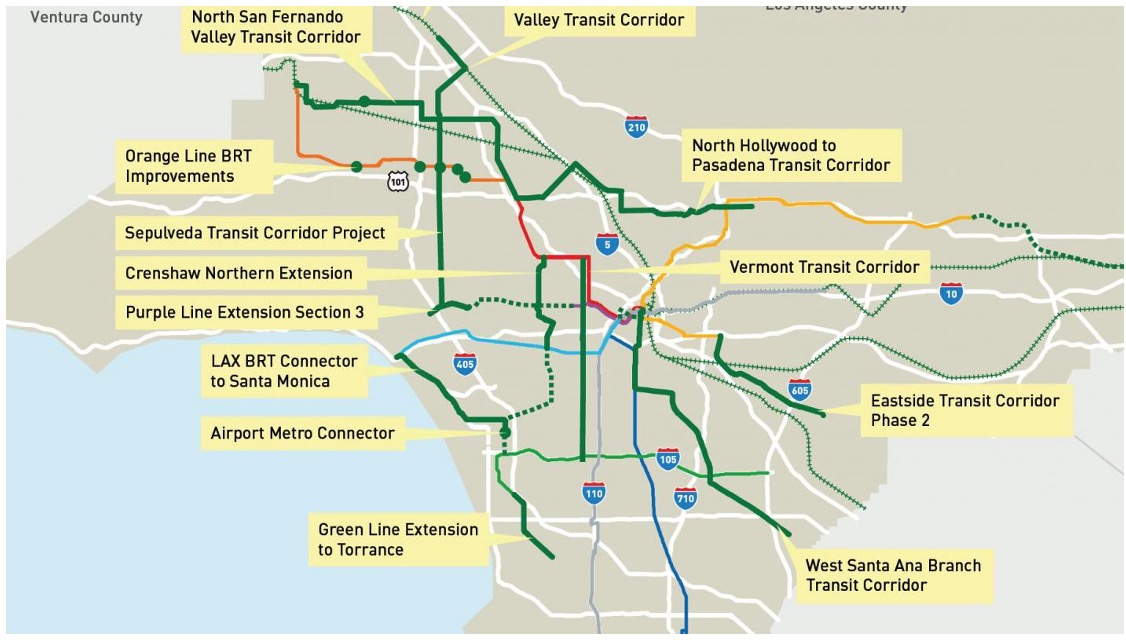
To reduce these emissions, it is essential that cars and trucks, including their supporting infrastructure, like roads, give way to mass transit done right. In this case right means much more than building the basic transit infrastructure of tunnels, tracks, and stations. It must also include passenger safety features, low-priced or free fares, and easy connectivity to multiple destinations. While this is a tall order for Los Angeles, New York City’s subway system demonstrates that it can be done. Even though the New York City system is old, newer mass transit systems, like Washington, DC’s, demonstrate that the NYC model can be successfully adapted to other cities. METRO has working transit models that could be replicated in Los Angeles.
For this to take place, however, two major obstacles must be overcome.
The first obstacle is cost. Previous mass transit systems depended on the Federal Department of Transportation for most of their funding. After decades of funding reductions, federal funding only covers 1/6 of transit costs. This has forced cities, counties, and states to fill the funding vacuum with local taxes. Like public housing’s demise, the primary reason for reduced funding is not a lack of money, but skewed priorities. After all, the Federal government has given $115 billion to the corrupt Ukrainian government, and the Biden administration has proposed $60 billion more. Had this money been spent on underfunded domestic mass transit systems instead of foreign proxy wars, new and upgraded transit systems could be thriving throughout the entire United States.
The second obstacle is design. When transit is not safe, affordable, frequent, accessible, and dense, ridership falls. These design requirements place a heavy financial burden on transit authorities, like METRO, to build transit correctly, including the inclusion of first-last mile public improvements. These design features include bathrooms; kiosks and street lighting; streetscape and landscaping; upgraded sidewalks and streets; wayfaring signs; and station accessibility for pedestrians, cars, taxis and Ubers, buses, and bicycles and scooters. Though essential to successful transit, they continue to be missing in METRO’s ambitious buildingprogram.
Nevertheless, there is no shortage of local, regional, and METRO manuals specifying exactly how first-last mile improvements should be integrated into transit systems. It is clearly not a lack of design standards that explains METRO’s and the City of LA’s failure to incorporate first-last mile improvements into new and existing transit lines. Even more distressing, METRO already completed a first-last mile plan for the Purple Line (D) Subway Extension in 2021. This, however, is hardly the end of the story since METRO side-lines its own plan. Since Purple Line/D subway construction is nearing completion, it is extremely late in the game to retrofit first-mile-last-mile design feature into the new subway.
Will METRO’s shoddy efforts finally change with the completion of existing projects and the construction of new projects, such as a westside Sepulveda Pass mass transit line connecting the San Fernando Valley to a terminus near the I-405 freeway? Not likely. I have reviewed METRO’s six Sepulveda corridor options, and I could not find any discussion of first-last mile components. While things could change, this process began in 2021, and the estimated completion of the first Sepulveda line is 2035. An unfunded second phase would extend the Sepulveda Corridor transit line to LAX by 2055. Based on METRO’s history, these dates are only estimates. For example, planning studies for the Purple Line/D subway on Wilshire Boulevard began 40 years ago, and the project is still not operational.
Conclusion: Transit is an essential component of any Green House Gas climate reduction program. But, to succeed transit needs to be done right, which means the integration of first-last mile features into light and heavy rail alignments. Since this is not happening in Los Angeles, declining ridership, like climate changes, is here to stay.
(Dick Platkin is a retired Los Angeles city planner who reports on local planning issues for CityWatchLA. He is a board member of United Neighborhoods for Los Angeles (UN4LA). Previous columns are available at the CityWatchLA archives. Please send questions to [email protected].)