

Temperature Increases Are More Dangerous Than Expensive Gasoline
PLANNING WATCH - As the price of gasoline soars, the mass media presents this as a major event – which it is -- but at the same time we lose focus on an even greater threat, rapidly rising temperatures.
It is easy to follow the mass media and zoom in on immediate threats while ignoring the long-term ones, especially temperature increases forecast to continue for the indefinite future. Nevertheless, the rise in heat, a product of burning fossil fuels, means that everyday life will eventually become unendurable.
"Temperatures become physically unlivable for humans at 35°C (95.6°F) at 100% humidity, a temperature at which people can no longer cool themselves through sweating. Extreme heat is already making parts of Asia, Africa, South America, Australia, and North America unlivable for older adults and severely restricting routine daily activities. Because our bodies depend on evaporation to regulate core temperature, both heat and humidity are critical.
The Lethal Limit: A temperature of 35° C (95 Fahrenheit) is the maximum for human survival, causing fatal heatstroke within hours.
The "Unlivable" Threshold: Regular routines become dangerous at 32°C (89.6 Fahrenheit), which have been occurring with increasing frequency.
Unlivable heat waves are accelerating. Major cities in tropical and subtropical regions will see millions of people exposed to deadly heat waves by the end of 21st century. For example, a UN report from 2022 warns climate change will make the world sicker, hungrier, and poorer, with an "unavoidable" increase in temperature.
The planet will still be livable in 2050, but it will look drastically different. Humanity is not facing extinction, but a massive degradation of the environment will appear. The poorest populations will suffer the most from extreme weather and resulting economic upheaval.
According to the UN Environment Program's GEO-7 report, by 2050 the Earth will experience severe climate shifts:
- Heatwaves will affect nearly everyone. Summer temperatures will soar, well above what is considered normal today, driving widespread blackouts and putting unprecedented burdens on energy grids.
- Up to 3.3 billion people, nearly one-third of the global population, will face severe water and food shortages. Erratic rainfall and intense droughts will cripple agricultural regions, sending grocery prices skyrocketing and pushing millions into starvation.
- Coastal communities will continue to face major flooding and shoreline erosion, forcing impacted cities to invest heavily in massive seawalls to survive.
- Ecosystems will be heavily damaged. Coral reefs are expected to disappear, and millions of square kilometers of natural spaces will be lost to agricultural production.
Livability will heavily depend on where you live:
- Regions near the equator, such as Southeast Asia, parts of India, and the Amazon, will face severe heat and humidity. These areas will become dangerously hot and difficult to live in.
- Northern climates (e.g., Canada, Scandinavia, and parts of the northern United States) will experience more temperate climates, which could result in mass climate-induced migration.
Will Humanity Survive? While the challenges are monumental, total societal collapse is not inevitable. Human survival and adaptability depend on rapid global action. Massive shifts away from fossil fuels are necessary, replaced by renewable energy sources, like wind, water, and solar. Limiting global warming to the UN's target remains the primary focus of international policy."
Sources for referenced material:
https://wedocs.unep.org/items/bba44efd-7715-4054-8432-92b270ee9d67
https://unfccc.int/sites/default/files/resource/UNClimateChange_AnnualReport_2022.pdf
Local temperature increases. What happens to the planet, spelled out in the UN reports, also impacts the Los Angeles area. These heat-related impacts are specifically detailed in the following study:
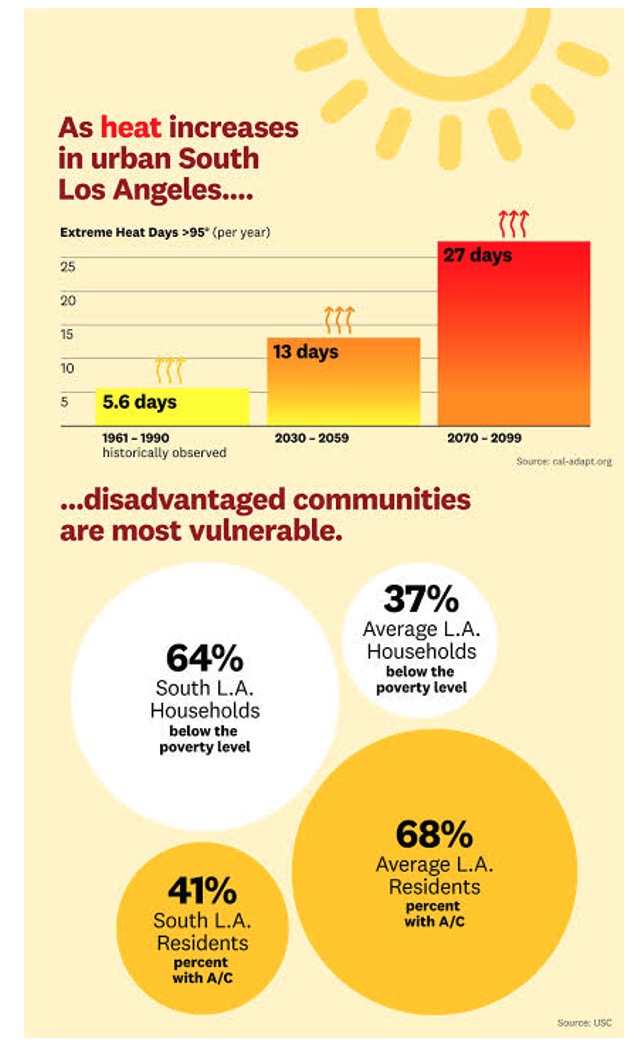
This graphic makes it clear that the poorest neighborhoods in Los Angeles will suffer the most from temperature increases. For example, from 2070 to 2099 South Los Angeles is projected to experience 27 days when there will be extreme heat. Furthermore, at present 59 percent of local residents do not have air conditioning, a situation which makes heat waves more deadly.
Los Angeles is known for its great weather, but many Los Angeles neighborhoods, like South Los Angeles, will be heavily impacted by withering temperatures in this century. A fraction of this heat cannot be eliminated, but most of the rise in temperature can be stopped.
While we know what to do, the big question is will governmental actions reduce the steady increase in temperatures. As long as the answer consists of a short-lived Mayoral report, get ready for blazing hot days in the decades to come.
(Dick Platkin is a retired Los Angeles city planner who writes about planning issues in LA. He is a board member of United Neighborhoods for Los Angeles (UN4LA). Previous columns are available at the CityWatchLA archives. Please send questions to [email protected].)