
Comments
GELFAND’S WORLD - We have a couple of high profile primaries about to occur. Of these two, the governor’s race is of more consequence because of the theoretical chance of finding two conservative Republicans in the runoff. That can happen if the Democratic candidates split the vote approximately equally among 4 or 5 candidates.
As many of us have mentioned, there is an obvious and acceptable cure: The Democratic Party voters (and the independents who generally vote for Democrats) should coalesce around 1 or 2 candidates so as to have at least 1 (and possibly 2) Democrats in the runoff election. This would effectively ensure a Democratic governor next year.
One observation: If you look at your Sample Ballot, you will find that there are a lot more than 8 candidates. Actually it’s more like five dozen. The majority fall under Republican, Democratic, and No Party, with a sprinkling of Libertarians et al. In practice, this means that serious voters will have to search to find their preferred candidates.
Back to the problem of Democratic voters coalescing around one or two candidates. The problem is that we don’t at the moment know who those 2 candidates are, or who they ought to be. The poll data go back to the time before the first debate, and even to the time when Eric Swalwell was in the race. There does not seem to be any new polls in these few days after the first debate. One interesting tidbit: Apparently Mahan did better than I thought, because I’ve had reader comments including support for Mahan based on his debate performance.
Perhaps we will have some new polling data a few days after the second debate (which occurs this Tuesday) and at that point, there ought to be some shift by voters who decide to jump on somebody’s bandwagon
As I mentioned in the previous column, the first governor’s debate was a real failure by the moderators. I have a couple of suggestions. As long as moderators continue to start off with some monstrous “gotcha” question, let me offer one. This question starts with the Republicans, Sheriff Bianco in particular: “Who won the 2020 presidential election?” If Bianco wants to insist that there was some sort of hanky-panky in a previous election, and since adherence to the claim that Trump won in 2020 has become something of a required proclamation among Maga’s, let’s give Bianco a chance to reply. Then put the same question to Steven Hilton, since he managed to glide on a lot of vague sorts of answers the last time around, and it is time that he got as good as he gave. Let the Democrats have at it too, although it shouldn’t be that controversial among their circle.
And one other thing. The first time a Republican refers to the Democrat Party, call him on the slur. It’s the Democratic Party, and it isn’t that difficult to pronounce.
And then, how about some solid questions that are not trick questions, gotcha questions, or just plain minor topics and irrelevancies? How will you balance the budget? If this involves making a cut in the gas tax, how much and for how long? Will you provide state funds for the Olympics? And so on . . .
Let’s see if the Democratic voters can start to coalesce around their one or two candidates in the post-debate period, say by a week from now.
A couple of thoughts about the mayoral primary, which will also be on the second of June.
The main question is whether Karen Bass can cobble together enough votes to win outright in the primary. Under Los Angeles city rules, a 50% (plus one vote) majority elects her, with no need to fight through the November runoff election. The most recent poll that I could find shows her at 25%. This really isn’t very good for an incumbent mayor. There are another 40% of L.A. voters who claim to be undecided. Perhaps I should have ended the previous sentence with an exclamation point. Incumbent Democrats in a Democratic city don’t usually have this kind of problem.
And then there are the opponents. Technically speaking, there are 16 candidates who are going to be on the ballot, but there are two who actually count. One is a Republican with Republican backing by the name of Spencer Pratt. The other is City Council representative Nithya Raman, who is considered to be to the left of Bass. Put the three candidates together and you have a spread among the Democrats plus a conservative Republican. To borrow an old remark from a long ago election, each of the two opponents offers “a choice, not an echo.” You can read a summary of this race here.
So there it is. Three candidates who, as of now, represent something less than 50% of the votes. The question is whether Bass can pick up enough undecideds on election day to craft a majority. Just thinking in terms of probabilities, it does not seem likely. But by the same probabilities, if she collects somewhere in the 40% range, she would have the inside track to finding another 10% in the November runoff. That’s what being the incumbent means.
Should there be a mayoral debate (presumably between Bass and her November opponent), the question I would like to hear is this: At what point are you willing to say No to ever-increasing salary demands from city employees? Why didn’t you say NO the last time around, when there was a surplus and there would be some chance to do what we’d like to do with the Olympics?
Addendum
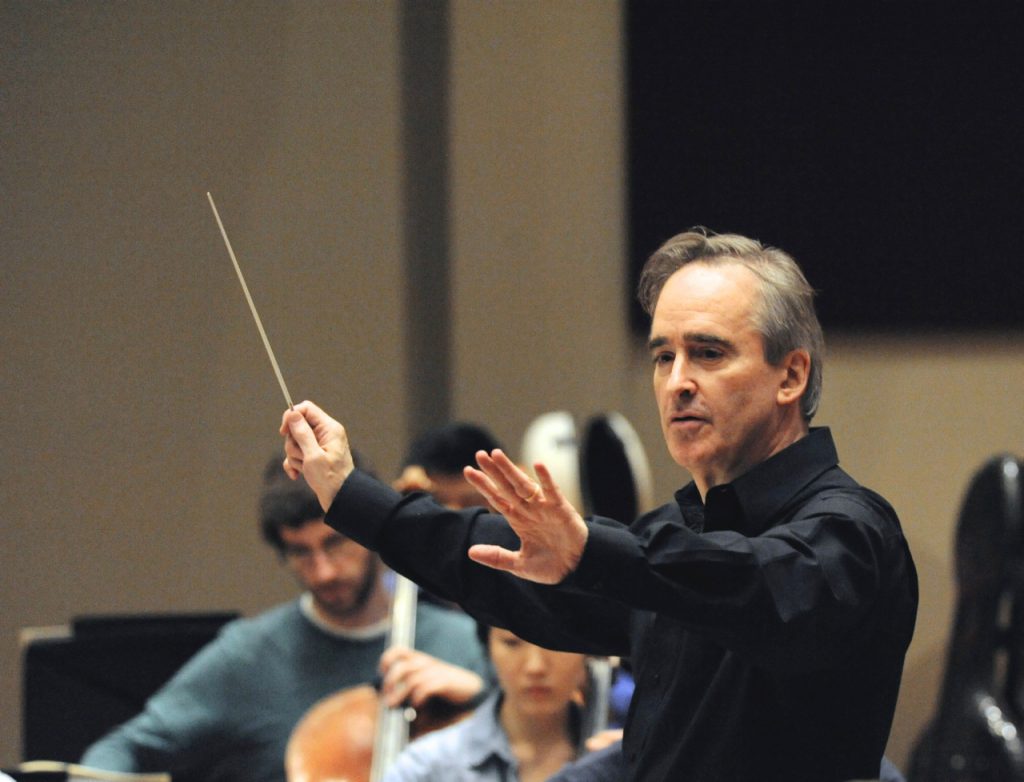
View from the Balcony on the James Conlon farewell concert.
Sadly, James Conlon will be stepping down, after 20 years, as the Music Director of the Los Angeles Opera. The company did a Farewell Concert (conducted by Conlon) last Friday, and it was both a surprise and a wonder. Naive audience members expected some celebrity splashed event with a lot of speeches and a collection of famous arias. Instead, we got some real opera sung as it should be sung and with orchestral playing as it should be played.
The program was divided into three parts. First, we heard excerpts from the last two acts of Verdi’s opera La Forza del Destino. This is an opera which doesn’t seem to be performed all that often. (I last heard it at the Chicago Lyric Opera more decades ago than I care to admit.) It can drag. In the hands of Conlon, Rodrick Dixon and Ernesto Petti made it come alive. Then we heard the Finale of Mozart’s opera The Marriage of Figaro. The cast included some of our home-grown singers (in the sense that they have participated in the local Domingo-Colburn-Stein visiting artist program).
Finally, we were treated to what the program referred to as Excerpts from Act Three of Die Meistersinger Von Nurnberg. This opera, usually referred to as Die Meistersinger, is Richard Wagner’s only comedic opera. Just to give you an idea of the music, I’ve put in a link to the overture, which you can find here. (Note: You have to scroll down to the second picture and click on it. Then play it loud.) The LA Opera rendition of the finale filled the orchestra pit with players, filled the stage with the chorus, and delivered the ending with enough volume to vibrate the rafters, if there are rafters. It was a great way for Conlon to finish his Music Director era.
The program introduced one other interesting note to the proceedings. Instead of politicians delivering long-winded speeches, the program included three short videos, each with a series of musicians and LA Opera board members who spoke of James Conlon and his many deeds. There was one comment which caught everyones’ ear: The L.A. Opera was, at one time, a good regional opera company, but under Conlon it has developed into a world class company. On one Friday night, this View from the Balcony found that this is, indeed, the case.
(Bob Gelfand writes on science, culture, and politics for CityWatch. He can be reached at [email protected])