
Wiener and Newsom Kings of Dysfunction
ABOUT CALIFORNIA -
“California doesn’t need enemies. It will collapse under the weight of its own moral illusions — a paradise destroyed not by hate, but by performative love.” Filmmaker Michael Moore
Metaphorically speaking, California’s body politic is like a drowning man. The political class, in pursuit of a few more pyrrhic victories, is willing to cling desperately and climb on top of any would-be rescuer and drown them to stay relevant and prove its moral superiority.
California was once the frontier of American dreams and imagination, a place where freedom, innovation, and optimism converged into a model for prosperity. California once had the largest middle class in the nation.
“California has declared war on its middle class, and the special interests controlling the state are doing everything they can to impose this punitive economic model on the rest of America. It’s a quasi-feudal system, with the entire population divided into aristocrats and serfs. The means to destroy the middle class is to engineer an unaffordable cost of living for households, and a regulatory environment that only huge corporations can afford to navigate. The moral justification for this destruction is to cope with the “climate emergency” and to achieve social “equity.” – California Policy Center
Today, California is an object lesson in decline: a state simultaneously drowning in wealth and dysfunction, governed by people who confuse moral theater with moral action.
The rot isn’t just political. It’s psychological. California has turned moral narcissism into civic religion, a culture that rewards those who perform compassion instead of those who produce results that actually improve people’s lives.
Nowhere is this pathology more evident than in its leadership class, figures like State Senator Scott Wiener, whose legislation exemplifies the transformation of governance into emotional exhibitionism. Moral narcissism thrives where competence dies. It’s the belief that good intentions matter more than consequences — that “caring” absolves leaders from accountability. Wiener has built an entire political empire on that principle.
From drug decriminalization and lenient sentencing to sweeping housing mandates, Wiener’s moral exhibitionism has produced a catalog of chaos: Each Bill has eroded public safety, homelessness has exploded, and housing costs have soared as consequences of Wiener's legislative record. These aren’t unintended consequences; they’re predictable ones.
Look, Senator Scott Wiener's (the king of moral nihilism) record of legislative actions, which could be seen as a form of moral nihilism, is a disaster of poor ideas that favor extreme agendas over the safety of families, children, and regular Californians. His bills don't just make small changes—they wipe out common-sense protections, transforming neighborhoods into crowded, unlivable areas with little parking and less community input, while reducing protections for minors and allowing predators to go free. Forget "progressive reform"; this is an outright harmful policy that damages real people. Here's a straightforward list of some of his worst proposals, drawn from conservative critics, political opponents, and public outrage. These aren't just "controversial"—they are recipes for chaos, exploitation, and decline. The deterioration of the quality of life in the State speaks for itself.
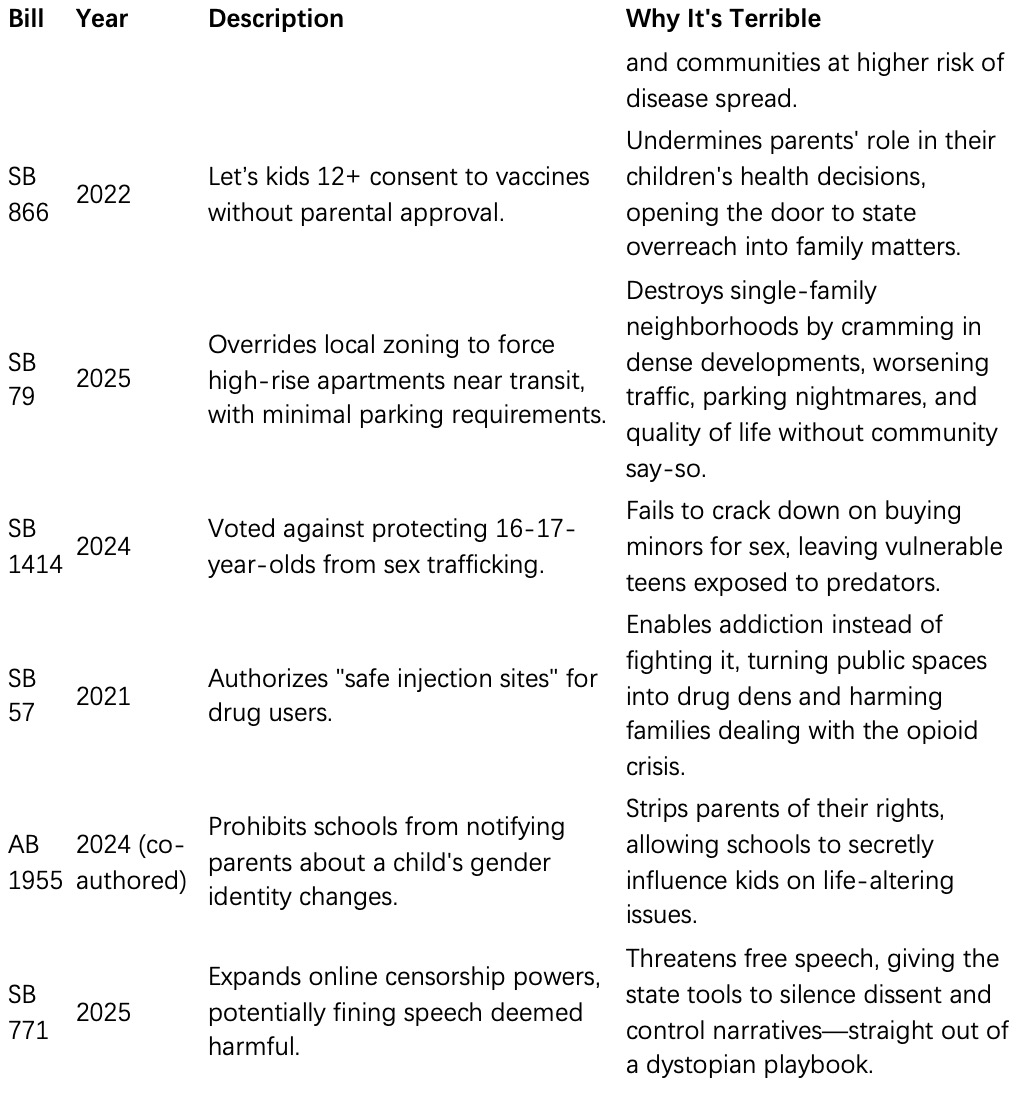
These bills paint a picture of a lawmaker who's all-in on weakening family structures, coddling criminals, and forcing unwanted urban sprawl. Critics like his 2024 opponent, Yvette Corkrean, call him a "menace" with pro-crime policies that have turned San Francisco into a nightmare. Right-wing voices and women's rights groups slam him for fueling Q-Anon-level conspiracies with real harms, like prison rapes and child exploitation. Even environmentalists pile on for bills like SB 4 that plop housing near polluting sites.
Each bill was promoted as moral progress. Each delivered social decay. The Public Policy Institute of California (PPIC) and California Business Roundtable (CBRT) have documented the fallout: declining safety, runaway costs, and evaporating trust. California’s ruling class now operates in a feedback loop of compassion: every failure repackaged as proof of caring too much, not too little.
When crime rises, it’s “restorative justice.”
When homelessness explodes, it’s “housing first” without treatment or conditions.
When businesses flee, it’s “climate leadership.”
Every law was built on pseudo compassion; each traded order for indulgence, pushing suicidal empathy to its fullest, dysfunctional expression.
- 171,000 unhoused residents (HUD, 2023).
- 47th in student proficiency (NAEP, 2022).
- 10,000 companies relocated since 2010 (CBRT).
Each statistic becomes a badge of moral struggle. The worse the outcome, the more righteous the intent. Why do voters tolerate this? Because they’ve been trained not to notice. Decades of educational and media conditioning have replaced reasoning with moral reflex. Schools once produced engineers and entrepreneurs; now they produce activists fluent in slogans but illiterate in cause and effect.
By the time those students become voters, they’ve internalized emotional narratives as civic duty. PPIC finds that two-thirds of Californians believe the state is failing, yet they re-elect the same incumbents. It’s not ignorance. It’s cognitive capture — a learned dependency on the moral story over the measurable truth.
Like lemmings, Californians march toward the cliff — not because they’re blind, but because they’ve been told the cliff is progress. Media narratives invert cause and effect: If businesses leave, blame greed. If families flee, blame housing demand and scream about affordability, then build more luxury apartments. If crime spikes, blame inequality and laud the benefits of restorative justice (translation: call a social worker). Every moral excuse guarantees the next failure.
California’s one-party dominance has eliminated real policy competition. When power becomes permanent, accountability dies. Governor Hair Gel presides like a CEO of virtue — polished optimism, blinders on, literally amid the smoking ruins.
Under his tenure:
- State spending doubled in ten years.
- Homelessness has nearly doubled since 2014.
- 340,000 residents fled in 2022 (U.S. Census).
- Only 31% of students meet grade-level math standards
- Median home prices exceed $900,000
- Small businesses face some of the harshest regulatory environments on Earth.
- Energy costs are the highest in America.
- The highest poverty rate in the nation (Census SPM).
- Regulatory complexity adds $130 billion to business costs annually (CBRT 2023).
- PPIC also reports that between 2019 and 2023, for large counties, retail theft increased significantly — e.g., about 70 percent in Sacramento, 65 percent in Alameda, 41 percent in San Mateo, and 40 percent in Los Angeles.
A San Francisco supervisor said it best: “We’re solving homelessness for the people we pay to manage it, not for the people living in tents.”
Each new mandate is justified as a moral duty, but the result is scarcity, which becomes another moral justification for more regulation and higher prices. The wheel turns endlessly. Regulation breeds scarcity, which proves virtue. Virtue demands more regulation. This is not progressivism. It’s cognitive euthanasia.
Yet the leadership narrative remains triumphalist. Every press conference beams: California is leading the way.” In what? In proving that ideology can bankrupt even paradise. This is not progressivism. It’s cognitive euthanasia. As Gad Saddd, a professor of Evolutionary Behavior, said, “A Society dies when it cares more about exhibiting infinite tolerance and empathy than invoking its survival instinct.”
The cure for moral narcissism, cognitive euthanasia, and suicidal empathy is empirical humility: the courage to face failure without emotional self-defense.
That means:
- Restoring logic, civics, and economics to education.
- Auditing homelessness programs. Funding based on results, not rhetoric.
- Measuring compassion through recovery rates rather than spending totals.
- Respect zoning and single-family neighborhoods, enforce laws, and reward competence.
- Allow markets to operate naturally rather than imposing outcomes through ideology.
Only when California’s voters rediscover thinking and common sense and elect result-driven leaders will the Golden State's decline be stopped.
(Eliot Cohen has been on the Neighborhood Council, served on the Van Nuys Airport Citizens Advisory Council, is on the Board of Homeowners of Encino, and was the president of HOME for over seven years. Eliot retired after a 35-year career on Wall Street. Eliot is a critic of the stinking thinking of the bureaucrats and politicians that run the County, the State, and the City. Eliot and his wife divide their time between L.A. and Baja Norte, Mexico. Eliot is a featured writer for CityWatchLA.com.)