
QUID PRO—OH NO!! Schiavo Self-Promotes With Her Own Op-Ed
MY ANALYSIS - Apparently, Quid Pro No struck a nerve. Hot on the heels of that story—and after months of strained exchanges with Sherwood Forest residents asking her for help—Assemblymember Pilar Schiavo has taken to the opinion pages to explain her commitment to housing, homelessness, healthcare, local voices and local control.
It makes for interesting reading when you have her own letters, legislative record and public statements sitting beside it. One sentence in her op-ed practically jumps off the page: “Sacramento has not always gotten that balance right.”
Sacramento? You are Sacramento. Or at least you were in June. Only three months earlier, Schiavo didn’t speak about “Sacramento” as some distant legislative life-form. During a June legislative hearing, she said “we.”
“We’ve removed CEQA, and we’ve done a ton of things to try to meet our housing need, and still not enough housing is being built, right?” Then, moments later: “Now we’ve removed a lot of barriers…”
There it is: We’ve removed CEQA. Not “Sacramento” removed CEQA. Not the Legislature. We.
CEQA is the California Environmental Quality Act. It requires government to identify and disclose potentially significant environmental effects and, where applicable, consider ways to avoid or reduce them. Of course environmental review can slow a project down. Sometimes slowing down is the point. Environmental review wasn’t put there as a “barrier.” It was put there as a protection.
And after describing what “we” removed, Schiavo supplied the uncomfortable conclusion herself: “Still not enough housing is being built.”
Well, if that’s the conclusion after removing all those “barriers,” perhaps residential communities need to be added to the endangered species list.
And perhaps “Sacramento” reached for the oldest redirection technique in the book: Look over here, not over there.
Look at the homeless. Look at seniors who can no longer afford their rent. Look at young families who can’t afford their first home. We have a housing crisis. We have to do something. All true. But while Joe Public was being told to look over there, “Sacramento”—Schiavo included—was busy over here dismantling protections in the name of building more housing, faster.
But building more housing does not create affordable housing. And somewhere in the rush remains that inconvenient question of capacity—water, power, sewers, roads, emergency access and evacuation.
Schiavo wasn’t merely standing somewhere in “Sacramento” while these housing laws were passed. She voted for them.
That becomes particularly difficult to ignore when her correspondence with Sherwood Forest residents is placed beside her new op-ed. She acknowledges a loophole. She writes that a developer “found a loophole in state law” and describes the resulting development as neither affordable housing nor what ADUs were intended to be.
Welcome to the loophole, Assemblymember. Your constituents have been living in it. They’ve watched houses come down while asking their Assemblymember for help.
According to Lee Kanon Alpert, Esq., an attorney and member of the Sherwood Forest Coalition, the Coalition sought letters from both Assemblymember Schiavo and Senator Henry Stern in support of its request for a City Interim Control Ordinance, or ICO. Alpert recalls that CD12 wanted that support before pursuing the requested ICO.
Alpert says Schiavo staff initially indicated she would consider the request and coordinate with Stern’s office on an acceptable joint letter. Weeks passed. The Coalition was later told that Stern’s office was preparing a revised draft. More weeks passed. Then, according to Alpert’s recollection, the Coalition was told the letter would not be delivered “at this time.”
Without it, Alpert says, CD12 told the Coalition it would not pursue the requested ICO. And there is an irony Alpert hasn’t missed: he says CD12’s proposed letter was substantially less specific than the housing concerns Schiavo would later raise herself in her op-ed.
Meanwhile, homes were being torn down. The bulldozer doesn’t wait for legislators to act. It keeps moving.
Then, months after residents began asking for help, their Assemblymember publishes an op-ed describing the problem they had asked her to address. What changed?
Schiavo now writes that residents deserve elected officials who will “listen, investigate the facts, and work to find a path forward.” Really, Pilar? Review your own letter.
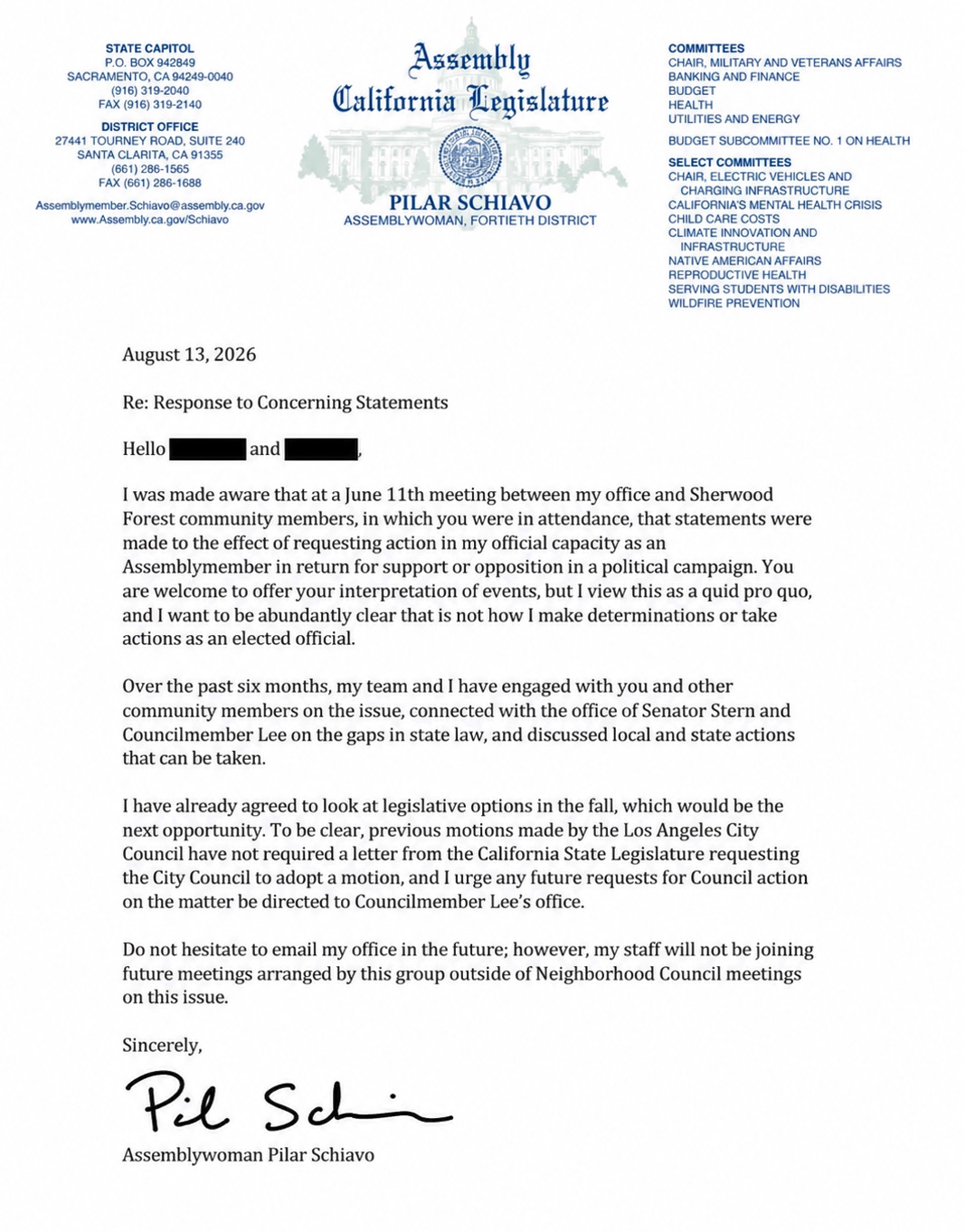
These constituents asked you to listen. They asked you to help find a path forward. Instead, the relationship ended with an allegation of a “quid pro quo.” That accusation was sent into their community well beyond the group advocating for help.
Schiavo could have simply said: I disagree with you. I’m not going to do what you’re asking. Instead, Schiavo accused members of the Coalition of a “quid pro quo” based on what she said occurred at a meeting she did not attend. A member of her staff was there. This allegation is serious. Yet the particulars were elusive. Then came the consequence: Schiavo told them they could continue emailing her office, but her staff would no longer meet with their group.
WHEN YOU ACTUALLY NEED YOUR GOVERNMENT
Most of us don’t interact much with government. We vote, pay taxes, maybe complain about a pothole. We assume government is there. It isn’t until we actually need it to act that we discover what having a representative really means.
Today, residents throughout the San Fernando Valley are getting their own education. They’re homeowners taking on the bulldozers and the bureaucrats.
Now, 46 days before Election Day, comes the op-ed. That timing doesn’t tell us why Schiavo wrote it. But it does tell us when.
She acknowledges the loophole. She acknowledges the legislation isn’t working as intended. She acknowledges that “Sacramento has not always gotten that balance right.” She now says communities deserve elected officials who will “listen, investigate the facts, and work to find a path forward.” The disconnect—and that is putting it mildly—is not lost on the constituents of Sherwood Forest.
THE ALTERNATIVE
Enter Rickey Hayes, Schiavo’s Republican challenger. In the San Fernando Valley, Hayes is making his case across traditional party lines on this issue. Why? Because, as I said earlier, some issues have nothing to do with party affiliation. Protecting your home, your family, your safety and your investment is one of them.
And on this issue, Hayes is speaking a very different language. So I asked him the questions I wanted answered.
When, if ever, should state housing legislation override existing zoning and a locally adopted community plan? Should there be exceptions for infrastructure, evacuation capacity, wildfire risk or other documented public-safety constraints?
“The only situation I could see this being a necessity would be under the rare chance that a project guarantees a true public benefit, like workforce housing. But some out-of-town investor creating rental property in a community they do not reside in is unacceptable. “Furthermore, there must be absolute exceptions for public safety. There is no circumstance where high-density housing should override communities that already lack electrical grid capacity, water infrastructure, clear egress and ingress routes for emergency services, and clear evacuation routes in the event of wildfires or earthquakes.”
Schiavo voted for SB 684 and SB 1123. She now says state housing law contains a loophole being used contrary to legislative intent. What responsibility do legislators have to examine foreseeable effects before restricting local land-use authority?
“Legislators have a responsibility and duty to look ahead and ask how legislation will possibly hurt their constituents. You have to begin from the point of identifying the hazards and figuring out how to overcome them. “You cannot vote for or push policy without identifying the weak points. If you rubber-stamp a housing mandate and don’t anticipate the loopholes, then you have to own that mistake and actively work on a solution.”
Should legislation that overrides local zoning or eliminates discretionary review be required to produce housing that is actually affordable?
“We don’t just have a housing crisis; we have an affordability crisis. People can’t afford the existing vacant housing. “So, if the state is going to mandate an override on a local municipality, that housing must be deed-restricted for working-class and middle-income families. If the housing is market-rate or luxury, it cannot fall into the group of projects that get to skip the line, avoid CEQA, and bypass the local neighborhood’s standard of approval. “Even then, they still must take into account the infrastructure, parking, and EMS issues we spoke of before.”
When legislators conclude that legislation they supported is producing consequences they did not anticipate, what responsibility do they have?
“Leaders have to own their mistakes. “If a decision is made that leads to unforeseen consequences, you have to step up and accept responsibility. You let the people know what went wrong and exactly how you will fix it. Legislators have to use the power of their office to halt the damage. “You don’t hide behind legislative deadlines and pass the buck to city council members who didn’t even vote for the legislation.”
Her constituents, however, have something considerably harder to rewrite: The record.
“We’ve removed CEQA.” “Still not enough housing is being built.” “Sacramento has not always gotten that balance right.”
Those aren’t our words. They’re hers.
An op-ed can change the narrative. It cannot change the record, undo the redevelopment that has already damaged this neighborhood, or stop the redevelopment occurring as I write. That was the urgency behind the public’s pleas for help.
Schiavo can write another letter. She can write another op-ed. But some things aren’t so easily walked back.
Words have consequences. Accusations have consequences. And once you’ve put either one into the world, you don’t always get to decide what happens next.
My father had a saying for moments like this. Pilar, someone probably should have told you this one:
“When you spit, you can’t put it back in your mouth.”
(Eva Amar is a West San Fernando Valley community organizer, contributor to CityWatch Los Angeles, and National Sexual Assault Victims Advocate.)