
Candidate Sarah Rascón Takes Corporate PAC Check, Breaks Promise
ELECTION 2026 - When candidates for public office seek support from voters by proclaiming purity from corporate donations, they often can point to their official disclosure reports as evidence of keeping that promise.
But not in the case of Sarah Rascón. The environmental advocate who formerly worked for Rep. Jimmy Gomez and did lobbying in Sacramento for big business is now making her first run for office in Eastside and Northeast L.A. for the open state Senate seat in the 26th District.
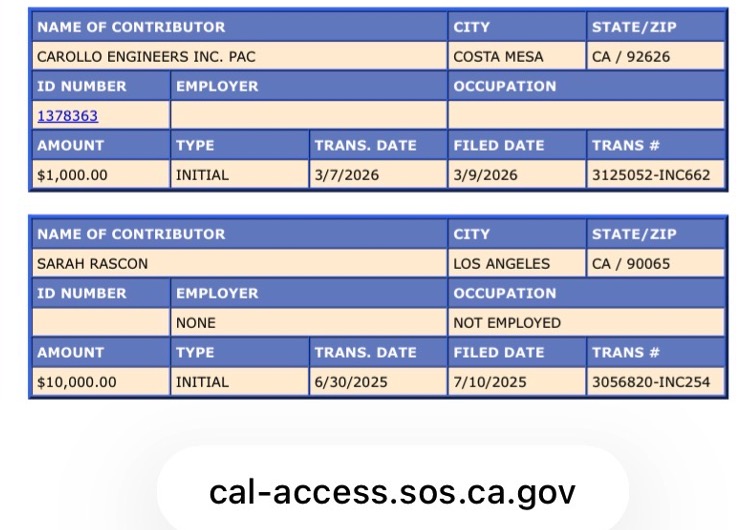
Rascón has made a promise of rejecting “corporate PAC money” central to her candidacy. That means taking no contributions for her campaign from political committees tied to business.
So then why does Rascón’s official campaign-finance disclosure report with the State of California show a corporate PAC donation in the amount of $1,000 that her campaign accepted on March 7, 2026?

For candidates, there’s a very clear difference between saying you’re swearing off corporate donations and not actually doing it. Compliance requires setting a priority with yourself, your team, and your treasurer to be scrupulous in fulfilling that promise. It may mean turning away pledges or donations that run afoul of that standard.
Failing to fulfill such a promise to the point that contrary evidence shows up in public records raises questions about the lapse. How serious and diligent is the campaign team? Was the promise just lip service? Was it pretense?
For voters, evidence of a contradiction like Sarah Rascón’s promise to reject corporate PAC money when in fact she accepted such money raises an important distinction.
There’s a difference between rejecting corporate donations altogether in the first place and adopting a posture of appearing untainted by corporate influence when such money may not materialize on behalf of the candidate as sizably or as soon as the candidate might have initially hoped.
That difference, one might say, is between a candidacy that is principled in foreswearing direct corporate donations from the beginning and a candidacy that proves unsuccessful in soliciting such money and then claims to be untainted by it as a form of phony virtue signaling.
The corporate PAC money taken by Rascón’s campaign sticks out like a sore thumb for another reason, too.
It’s not the first discrepancy about corporate influence affecting Rascón’s candidacy.
Rascón suffered a setback in July when her past work for the L.A. Chamber of Commerce became more widely known to voters. That work involved lobbying in Sacramento for the interests of the Chamber’s members. Those members include warehouse and cold-storage companies similar to Lineage Logistics in Boyle Heights, site of the catastrophic fire in June and ongoing public-health disaster. Constituents of the 26th state Senate district, including in East L.A., are very much affected by the Lineage disaster.
Attempts by any candidate to claim purity in a campaign for public office can be more than a rookie mistake. Such promises often fail because they prioritize appearance over action, and they don’t focus on delivery of results to constituents or improvements for communities. Making such a promise can sound nice, but breaking it can shatter trust and ruin a candidacy.
It’s the duty of careful voters to catch discrepancies in claims made by candidates and to be skeptical of virtue signaling, especially when evidence reveals it to be false.
(Hans Johnson is a longtime advocate for LGBTQ+ rights, environmental justice, and public education. His columns have appeared in USA Today and leading newspapers across more than 20 states. Based in Eagle Rock, he serves as president of East Area Progressive Democrats (EAPD), California’s largest grassroots Democratic club with over 1,100 members. Hans brings decades of organizing and policy experience to his work, advancing equity and accountability in local and national politics.)