
What Can One Photo Tell Us About Homelessness?
iAUDIT! - One of my regular readers recently sent me a photo of a homeless woman lying on a sidewalk:
For anyone living in Los Angeles, there is nothing unusual about the photo. There are few places in the city where you cannot find an unhoused person on the sidewalk, hunched over on a bus bench, or living in a tent. But there’s more to the picture than you may initially see. First some context: the photo was taken at a strip mall on the corner of Manchester and Sepulveda in Westchester. According to the person who sent me the picture, the woman was not in obvious distress. She was merely lying on the sidewalk. If you look closely, you’ll notice she’s not wearing shoes, but her clothes are reasonably clean. Whatever she possesses in this world or was given to her by the people who left her there, is probably in her small shopping bag. Again, at first glance, there is little to distinguish her from the other 46,000 homeless people in LA.
But there are two things that make this photo unusual; one you can see and one you cannot. What you can’t see is that she is in CD-11, Councilmember Traci Park’s district. Park is one of the more aggressive proponents of Municipal Code 41.18, which prohibits encampments near sensitive areas like schools. She has also sponsored ordinances to restrict derelict RV’s on city streets.
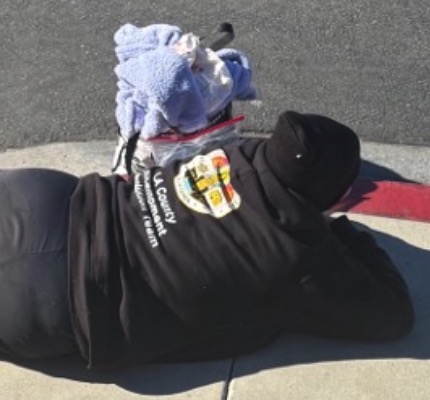
What you can see is related to the location. if you zoom in on the photo, you may see she is wearing a T-shirt with the LA County seal on the back. Beneath the seal are the words “LA County Encampment Resolution Team”. If you google that term, it takes you to the County’s website for its Emergency Centralized Response Center. Its services include, “Accepting and processing referrals of unsheltered encampments and/or individuals/families and dispatching an outreach team for assessment and follow-up. In addition, ECRC coordinates and supports homeless outreach and encampment resolution efforts such as Inside Safe, Pathway Home, and other jurisdictional encampment effort”. Reading through the website, one gets the impression the ECRC is a comprehensive all-encompassing program that seamlessly coordinates services to get people off the street and into transitional shelters where they can get the services they need. Read a bit more closely, though, and some anomalies stand out. First, the ECRC claims it coordinates the activities of a dizzying array of County departments: the Departments of Mental Health, Health Services – Housing for Health, Public Social Services, Military and Veteran Affairs, Public Works, Public Health – Substance Abuse, Prevention, and Control; and even programs of the Los Angeles Homeless Services Authority, (LAHSA). However, the findings from a court-ordered review of homelessness programs made it clear there is little or no coordination among city, county, and LAHSA programs. The program description for Pathway Home, the County’s primary encampment clearance and shelter/housing program, says the program has cleared 66 encampments since its inception in 2023 and moved 1,831 people into interim housing. These numbers are similar to the City’s Inside Safe program. However, unlike the City Controller’s dashboard, the County web page does not show expenditures nor the number of people who fell back into homelessness.
Another concerning note is that despite its designation as an “emergency” center, it is only open during normal business hours: Monday through Friday from 8:00 a.m. to 5:00 pm. The web page does note outreach takes place seven days a week but does not say how outreach teams follow-up outside of business hours.
So, the ECRC supposedly coordinates the activities of county departments that are known for their lack of coordination and inconsistent services. And apparently the definition of “emergency” does not include nights and weekends.
What does that mean for the lady in our photograph? Judging by her T-shirt, she’s had some kind of encounter with a County Resolution Team. We can’t know the nature of the encounter or encounters, but since it’s an encampment resolution program, we can reasonably assume she was living on the street elsewhere and somehow wound up on the sidewalk in Westchester. Remember, the ECRC is a County program, so wherever she may have been camped, it was not within LA’s city limits. The City has Inside Safe and other encampment clearance programs of its own. That begs the question, if the ECRC says it provides seamless services to move people from encampments to shelter, how did this lady end up on a city sidewalk?
Again, we don’t know the specifics of this lady’s circumstances, but the photo is indicative of one of the most pernicious myths told by homelessness program leaders. That myth is that the City, County, and LAHSA have a comprehensive plan to address homelessness. We know from a host of reports and audits that there is virtually no coordination among the three primary agencies that should be serving the unhoused. I have written several columns on the subject, including this one. Consider this; the County’s Pathway Home website states, “This Pathway Home dashboard excludes data from our encampment resolution partnership with the City of Los Angeles”. Theoretically, the people assisted by the County are not counted by the City, and vice versa. However, assuming this lady was somehow served by County teams, she was no doubt included it the ECRC’s program statistics. Then she appeared on a city sidewalk. Let’s assume for the moment she was then approached by a city team (the photo was taken less than a mile from Westchester Park where the City houses a CIRCLE outreach team). She would be counted as unique by the provider and run through the city’s system as a “new client” even though she’d been contacted by County teams. When auditors say the same people can be counted more than once, this is one of the many ways that happens.
The lady’s presence on a sidewalk in CD-11 also exemplifies the city’s disjointed homelessness response. As I mentioned, Councilmember Park makes use of the city’s encampment clearance ordinance more frequently than some of the other members. However, some of her counterparts, including Councilmembers Raman, Hernandez, and Soto-Martinez often ignore requests from their constituents for encampment clearances, in favor of expensive and repetitive outreach efforts that do little to reduce homelessness but do provide robust income streams to their favored nonprofits. Despite the City’s claims of robust and comprehensive homelessness solutions, each Councilperson can choose which, if any, policies he or she wants to pursue. So, even if Councilmember Park chooses to pursue encampment clearings, people can simply move elsewhere and set up a new camp. Indeed, as I pointed out in a previous column, this uncoordinated approach even leads to inequities within districts, as residents of cleared encampments move a few blocks. As I quoted a city official in that column, those inequities are exacerbated by the fact that nothing prevents campers from moving back into cleared encampments, sometimes on the same day. The result is that the City is engaged in a near-endless cycle of moving the same people from one encampment to another. As shown in many reports and audits, including the one ordered by the court, each encounter comes with the risk of counting a person more than once as they enter, leave, and reenter the intervention system.
We must resist the temptation to use the woman in the photo as a symbol. Whatever the reason she became homeless and whatever the circumstances that brought her to a Westchester sidewalk, she is a human being who deserves the dignity of decent shelter and effective services. Perhaps the greatest tragedy is that, given the City’s ineffective programs, we have no reason to believe she is any better off today than when she was found lying in a public walkway.
(Tim Campbell is a longtime Westchester resident and veteran public servant who spent his career managing a municipal performance audit program. Drawing on decades of experience in government accountability, he brings a results-driven approach to civic oversight. In his iAUDIT! column for CityWatchLA, Campbell emphasizes outcomes over bureaucratic process, offering readers clear-eyed analyses of how local programs perform—and where they fall short. His work advocates for greater transparency, efficiency, and effectiveness in Los Angeles government.)