

The Reason Utility Bills are Going Up in Los Angeles Is Likely More Diverse Than You Think
COST OF UTILITIES - Many Angelenos are opening their utility bills and feeling that something is different: the bill is getting higher. For households already balancing the rising costs of housing, food, insurance, and transportation, increases in yet another bill can create genuine financial strain.
And the truth is, just like many things these days, utility bills mailed by LADWP are going up too. But, when it comes to the LADWP bill and all the different services it includes, increases in that bill are actually driven by a combination of distinct levers.
Performing bill comparisons to understand why bills are going up usually requires a look at the cost of multiple city services.
When it comes to comparing this month’s utility bill to the one received two months ago, or even a year ago, there are several factors in play that lead to different billing amounts. Weather, seasonal usage, household changes, and approved adjustments for electric, water, sewer and trash rates increases can all affect the amount charged. That is because utility bills mailed from LADWP contain charges from up to four different city services – power, water, trash and sewer.
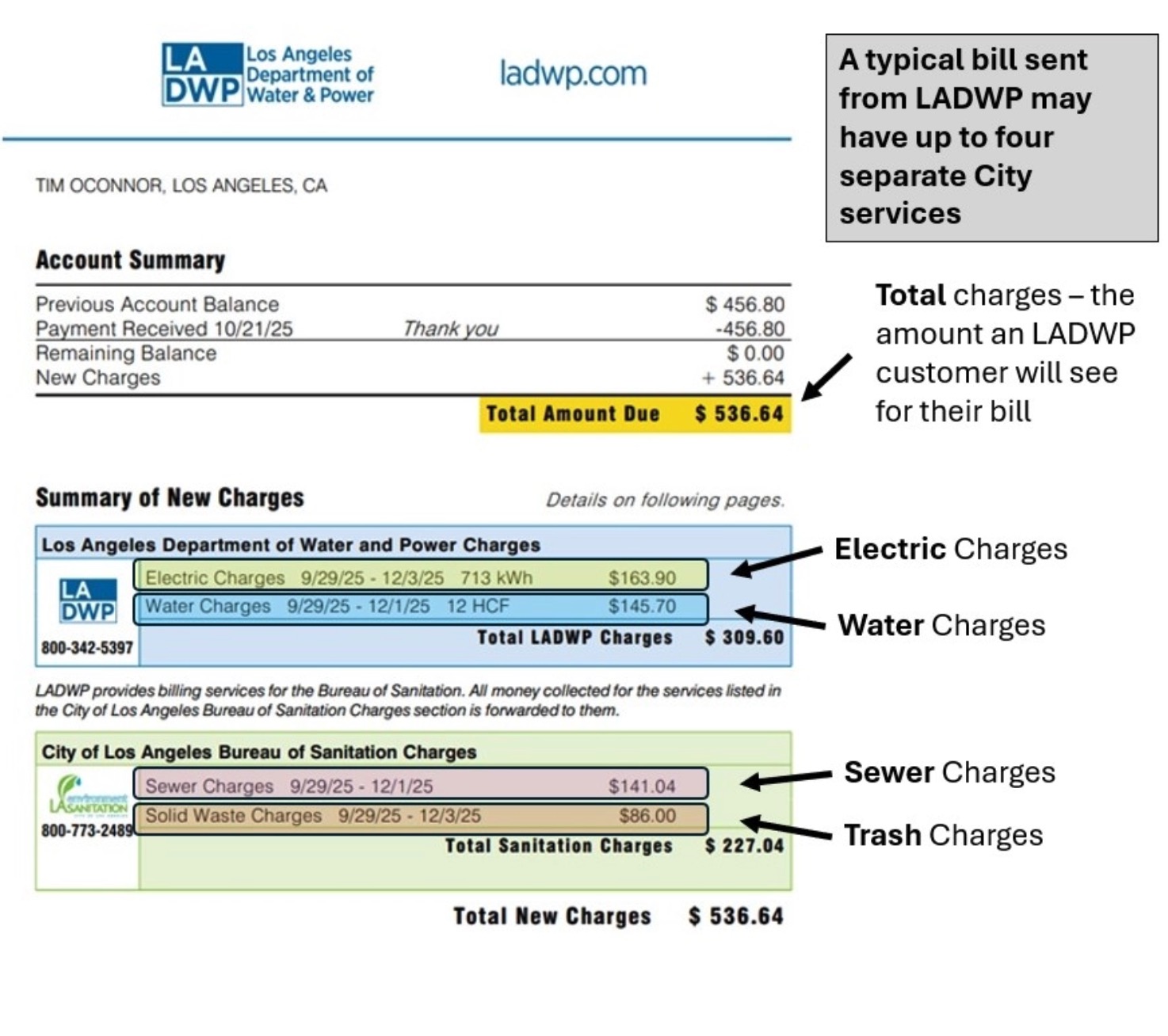 Here is a copy of my own LADWP bill – see that it includes 4 separate charges for the period from September 29, 2025 to December 3, 2025.
So, to understand why utility bills in the City are going up it’s important to first understand the services included on the LADWP bill – and how costs to maintain the massive system that keeps those services running are impacting it.
A Look at Water and Power Cost Drivers
As written about in OPA’s Primers on Water and Power rates, LADWP charges customers for water and power use at rates that are approved by the LADWP Board of Commissioners and City Council. These rates are structured in tiers, so the more people use the more they pay for each unit used. Rates are also regularly adjusted so that the utility has enough revenue to pay for system investments and cover costs to deliver clean and reliable services.
Alongside the cost of almost everything in society, the cost of maintaining the aging and increasingly complex LADWP water and power system has increased over time, resulting in increased water and power rates in recent years. These investments are key to keeping the system reliable and clean, but also incur costs. For example, in September 2025 the LADWP Board approved expenditures which resulted in an increase of roughly 2.7% on the median residential customer’s electric bill and 3.6% on the water bill.
Although gradual rate increases in water and power rates aren’t traditionally felt by consumers in the short term, they can add up over time. However, even with these increases, LADWP power rates remain lower than large investor owned utilities like nearby Southern California Edison. Further, adjustments to water and power charged by LADWP fund essential needs like purchasing water to supply the regional system, fuel for power plants, infrastructure renewal, wildfire prevention, debt service, safety requirements, and major capital improvements.
A Look at Trash and Sewer Cost Drivers
As shown by the bill excerpt, the LADWP bill can also include more than power and water charges. For many customers, it also combines charges for Solid Resources (trash)and Sanitation (sewer) service on the same statement. While LADWP does not manage these specific services, they act as the central billing agent for LA Sanitation to streamline city services into one single monthly statement. When the cost of any one of these services increases, the total amount due on the LADWP mailed bill also rises, even if electricity or water rates and usage stays the same.
Recently, the Los Angeles City Council approved increases in sewer and trash rates. A look at the drivers behind these increases shows a similar theme to the drivers behind water and power increases – funding essential city projects and services such as aging infrastructure repairs and improvements, pipe rehabilitation (sewer), water reclamation plants (sewer), water quality monitoring (sewer), recycling (trash), waste diversion (trash), and state mandated environmental compliance (both). As a result, even though trash rates in Los Angeles still track below the costs charged in some nearby cities, many households have seen higher overall bills recently.
Weather and Household Routines Can Also Drive Real Changes in Water and Power Use, Sending Bills Up
Changes in the amount of power and water used by a customer can sometimes be invisible and unintentional, especially during hotter, longer summers, or delayed winters – with research on real billing data showing that residential electricity demand rises markedly as temperatures climb. In Southern California, late-season heat can significantly increase air-conditioning use, and that additional consumption is reflected on the utility bill. And as customers use more energy, reaching into higher cost tiers and resulting in higher cost Power Access charges.
Water shows a similar pattern. Outdoor irrigation can account for a large share of residential use, particularly during warm and dry months, and delayed wet winter weather. When high temperatures persist late into the year—or rain arrives later than usual—households may irrigate more without realizing it, pushing water use into higher tiers with higher per-unit charges.
Changes inside the home also matter: new appliances, EV charging, children home from break, more time spent working from home, plug-in space heaters running in a chilly room, or A/C units running more frequently can all add up. These shifts do not mean anyone did anything “wrong”—they simply highlight how sensitive bills can be to changes in weather and routine.
When Multiple Factors Overlap, Bills Can Rise Quickly
For many households, recent bill increases reflect several factors operating together:
- Gradual water and power rate increases push per-unit charges higher
- Trash and sewer rate increases push monthly charges higher
- Hotter temperatures and dryer conditions lasting later into the fall and winter result in more cooling and more watering, which in turn leads to higher electricity and water use, which then pushes consumers into higher use tiers and higher bills
- Shifts in household habits such as working from home or running more frequent laundry and dishwasher cycles, increasing overall consumption leading to higher use tiers and higher energy bills
When these factors converge, the resulting bill can be a significant shock—and it is entirely reasonable for customers to expect a clear breakdown of what is driving those costs. In addition, since customer participation in rebates and programs that promote energy efficiency and water conservation can help keep costs low and manageable, it’s important for customers to know where to go to find resources and help. Further, with programs like Level Pay that allow customers to spread out the cost of utilities over a 12-month period, making bills more predictable and manageable, its critical for customers to know how to qualify and participate. For these and more – resources like from LADWP can make a major difference. Check out the links above for more detail.
At the Office of Public Accountability, we will continue to push LADWP for transparency, accountability and access so customers can have the confidence their bills reflect reasonable costs of delivering the safe, reliable and clean service they rely on.
(Tim O'Connor is a data- and evidence-driven energy and accountability expert with more than 25 years of experience advancing pragmatic solutions to complex public-policy and infrastructure challenges across the utility, transportation, and sustainability sectors. A Los Angeles native, he has led teams in government, consulting, and nonprofit roles, with deep expertise in utility investment planning, decarbonization, clean technology deployment, and equitable access to affordable energy. Tim joined the City of Los Angeles in 2025 after senior roles at Deloitte Consulting and the Environmental Defense Fund, and holds degrees from the University of Oregon, Duke University, and Golden Gate University School of Law.)