Comments
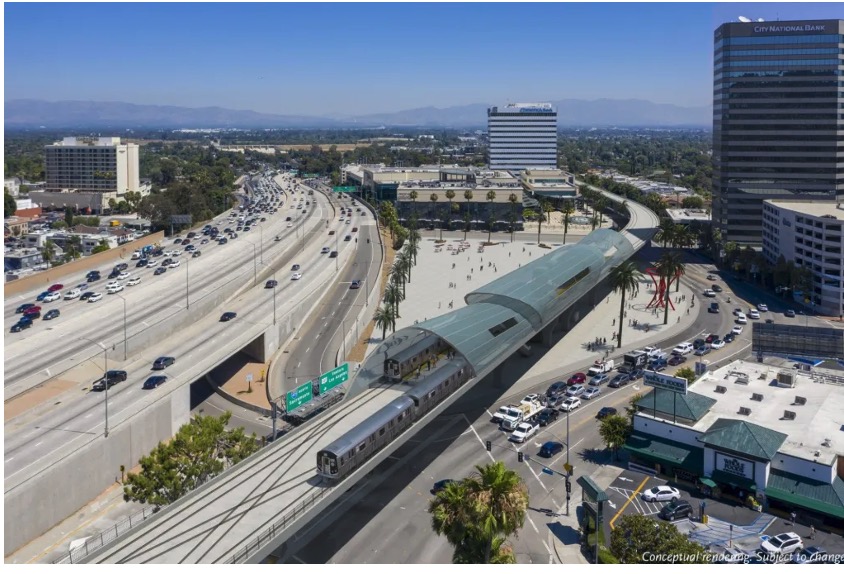
LA WATCHDOG - After more than four years and $250 million, Metro finally announced its plan to connect the San Fernando Valley and the Westside. While the long-term plan is to eventually connect the Van Nuys Metrolink station to the Expo (E) Line, the initial phase will begin in North Hollywood at the G Line and underground south to Sherman Oaks to UCLA and the proposed D Line station at Wilshire Boulevard in Westwood.
Metro is promoting the benefits: significantly less congestion and faster travel times, improved connectivity, job creation, billions in construction wages, increased economic output, and numerous climate initiatives, including reductions in vehicle miles travelled, greenhouse gas emissions, and smog.
Metro does not mention that the completion of the proposed Sepulveda Transit Corridor will take at least twenty years to complete. Just imagine twenty years of construction and commotion.
Metro does not address the financing of this project that is expected to cost $24.2 billion in 2023 dollars. Resources, however, are limited to $2.54 billion from Measure M, the half-cent sales tax that was approved by voters in 2016. To bridge this almost $22 billion gap, Metro is looking for funding from federal, state, and local resources as well as from public-private partnerships.
Of course, the shortfall is bound to increase because of inflation since 2023 and the fact that Metro projects have a history of not being on time and substantially over budget because of poor project and executive management. Several critics have said this is a $40 billion boondoggle.
For the most part, the burden will be borne by county and city residents. This may include a new half-cent increase in our sales tax, the issuance of bonds backed by yet another property tax, a parcel tax, or combination of these taxes.
There is an alternative that Metro needs to reconsider: congestion pricing.
In 2019, in conjunction with Mayor Garcetti’s Twenty-Eight by ’28 Initiative, Metro investigated three congestion relief pricing plans: VMT (vehicle miles travelled), cordon pricing when entering a certain area such as DTLA, and corridor pricing for roads such as the 10 West to Santa Monica.
Corridor pricing for the Sepulveda Pass is essentially a toll road. Any plan includes developing a revenue model (tolls), analyzing pricing during peak hours and non-peak hours, the impact on congestion and the number of cars using the 405, the use of money derived from this plan, pricing policies for low-income drivers, and how to mitigate the impact on local neighborhoods and their residents. It may also require high frequency express buses.
Do we want to spend upwards of $30-40 billion over the next twenty years and have significantly higher taxes? Or do we want congestion pricing that will generate revenue that can be used to improve the impacted communities? The answer is simple, congestion pricing, in large part because we cannot trust Metro, its management, and the politicized Board of Directors led by Mayor Karen Bass and Supervisor Lindsey Horvath.
(Jack Humphreville writes the LA Watchdog column for CityWatch, where he covers city finances, utilities, and accountability at City Hall. He is President of the DWP Advocacy Committee, serves as the Budget and DWP representative for the Greater Wilshire Neighborhood Council, and is a longtime Neighborhood Council Budget Advocate. With a sharp focus on fiscal responsibility and transparency, Jack brings an informed and independent voice to Los Angeles civic affairs. He can be reached at [email protected] )