

Senator Schiff Proposes Legislation To Address This Country’s Housing Crisis
PLANNING WATCH - California Senator Adam Schiff has introduced legislation to address this country’s worsening housing crisis. So far, so good. Year-by-year the number of homeless and overcrowded people have increased, especially in California. His legislation hopes to address this worsening housing crisis by creating more affordable housing, largely through a private sector building boom.
While Senator Schiff deserves praise for acknowledging that there is a serious low-income housing problem, especially in California, the jury is out whether his legislation will find a Republican co-sponsor. Even if this hurdle is overcome, an even larger barrier remains. If adopted and signed by President Donald Trump, will Senator Schiff’s proposal actually work? Will the homeless and overcrowded finally get a decent place to live?
But Senator Schiff never mentions the connection between the Federal budget’s military priorities and growing homelessness and overcrowding. He is silent on $23 billion in US military aid to Israel, $175 billion the US government has so far spent on the Ukraine War, and $1.5 trillion per year spent by the Pentagon and related Federal agencies on “defense.”
If Senator Schiff managers to find a Republican co-sponsor for his bill, and if his proposed housing legislation is then approved by Congress and signed by the President, this is what to expect:
- Expansion of the Low-Income Tax Credit.
- Middle-income Housing Construction loans ($10 billion).
- Workforce Housing Block Grant Program ($5 billion).
- Housing Accelerator Program ($1 billion).
- Increased Community Development Block Grants ($4.2 billion).
- Reestablish the National Disaster Resilience Competition ($1 billion).
- Increased funding for the Rural Rental Housing Program ($70 million), Indian Housing Block Grant Program ($200 million), Supportive Housing for the Elderly ($1.7 billion), Supportive Housing for People with Disabilities ($360 million), Homelessness and Supportive Housing ($5.45 billion), and the HOME Investment Partnership Program ($2.5 billion).
- Housing Opportunities for People with AIDS ($750 million).
- Grants for converting Hotels and Motels into Emergency Shelters ($250 million) and local Government Buildings into Affordable Housing ($750 million).
- Substance Abuse and Mental Health Services Administration ($1 billion).
- Tenant support ($150 million).
- Fair housing.
If adopted, will Senator Schiff’s bill solve chronic homelessness and overcrowding in the USA? My answer is not likely, despite his good intentions. This is why:
First, the main cause of growing homelessness and overcrowding in the United States is static real wages over the past half century. The following chart reveals that from 1970 to 2023 inflation-adjusted wages declined for most people in the United States. Until wage stagnation is addressed by inflation-matching raises, homelessness and overcrowding will continue to grow in the United States. While Senator Schiff’s legislative proposals might slow this increase, it will not reverse a trend that began under the Nixon administration in 1970.
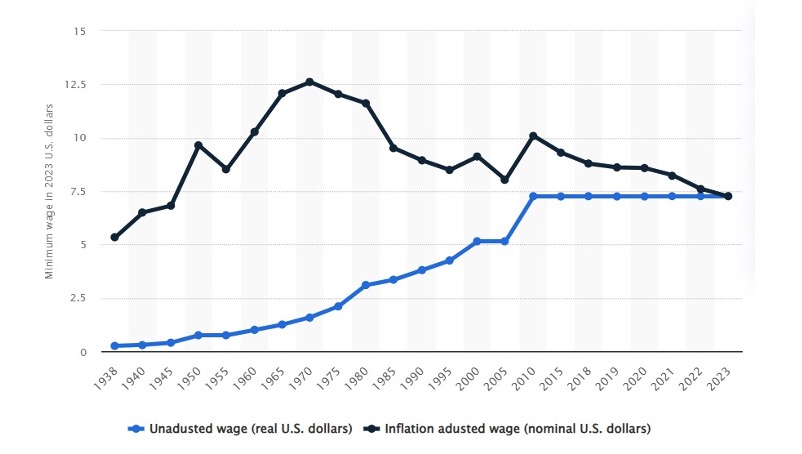
Second, inflation is now increasing, and this, too, will increase homelessness and overcrowding since the price of housing continues to rise faster than wages.
Third, Senator Schiff’s bill is premised on building new, affordable housing, even though there are 16 million vacant houses in the United States. As for apartments, the national vacancy rate is 8.4 percent. In Los Angeles, 4.8 percent of apartments are vacant. In greater Los Angeles, according to the Wall Street Journal, there are 150,000 vacant houses, although many of them are owned by speculators. Nevertheless, the homeless and overcrowded in Los Angeles have enough vacant homes and apartments they can buy or rent. Unfortunately they don’t have enough money to do so, an obvious point that Senator Schiff’s proposed legislation ignores.
Sad to say, that even if Senator Schiff gets a Republican co-sponsor, and even if his bill is approved and signed, most of the homeless and overcrowded won’t be affected.
(Dick Platkin ([email protected]) is a retired LA city planner. He reports on local planning issues and serves on the board of United Neighborhoods for Los Angeles. Previous columns are available at the CityWatchLA archives.)