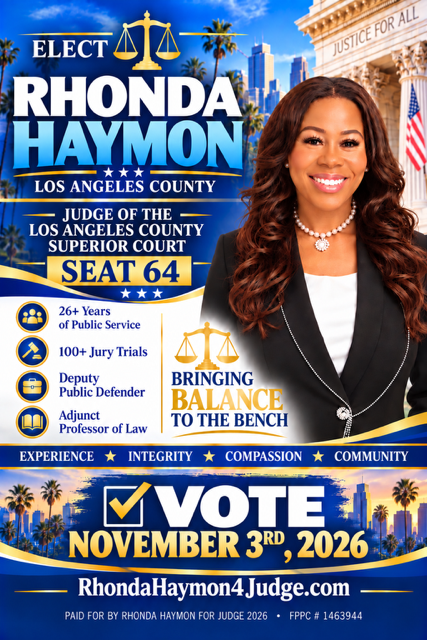
WESTSIDE - I met Rhonda Haymon last Monday on a sunny afternoon in Venice Beach as she was smartly dressed in a brown suit ready and excited to discuss her candidacy and purpose for seeking a seat on the Los Angeles County Superior Court.
Describing herself as a "neighbor, home grown, and ripe and ready for the bench," the 52-year-old Gardena resident and homeowner is divorced with a fifteen-year-old daughter. A 23-year veteran of the LA Public Defender's Office and a graduate of Tuskegee University where she earned her BA in Political Science and her JD from the Willamette University School of Law in Salem, Oregon.
A former Adjunct Professor at Southwestern Law School here in Los Angeles,
She is also a proud member of the sorority Delta Sigma Theta, as well as a former member of the Oregon Bar. Her candidacy was rated "qualified" by the Los Angeles County Bar Association.
Haymon earned the nickname "Ms. Acquittal" due to her extensive record of winning criminal cases and defending clients facing severe charges. Haymon has litigated over 100 jury trials, both felonies and misdemeanors, and has a proven expertise in immigration cases as well as domestic violence and issues of homelessness and mental illness.
"The bench should reflect the community which it serves, and I'm a part of that reflection," noted the candidate.
Haymon brings several impressive endorsements to the campaign including Los Angeles Mayor Karen Bass, Los Angeles County Supervisors Lindsey Horvath and Holly Mitchell, as well as a "recommendation" from US Representative Maxine Waters (CA-35). She also received the support of LA County Public Defender Ricardo D. Garcia, the first Latino to serve in that role.
Finishing a close second in the June 2nd Primary with 42.17% or 717,844 votes, Haymon has secured the endorsement of third-place finisher Francisco Amador, who garnered some 235,003 votes, or nearly 14%.
Viewing the general election as a brand-new race, Haymon is working consistently and enthusiastically meeting voters and spreading the message of her campaign as the contest heats up with the end of summer and election day just around the corner.
Below is my complete Q&A with the candidate:
1. What Are Three Specific Policies You Plan to Introduce if Elected?
Judges do not create policy in the way legislators do; we interpret and apply the law. However, there are three core areas that would define how I administer justice:
A. Equal Access to Justice
I am a native of Los Angeles County. I was born and raised here, I live here, and I have spent my career serving the people of this county. That lived connection has allowed me to understand the diversity of the communities that come before the court.
I will provide meaningful access to justice not only through the application of the law, but through the ability to make the law accessible to the people standing before me. For 26 years as a Deputy Public Defender, I have explained the law to people from every walk of life, every socioeconomic circumstance, and many different cultural backgrounds. I understand that access to justice means very little if a person leaves the courtroom without understanding what happened, why it happened, or what is expected of them. I bring the ability to communicate the law in a way that reaches people while never diminishing the authority or integrity of the court.
B. Meaningful Access to Restorative Justice
When authorized by law and appropriate to the individual, restorative justice must be more than an option that exists on paper. Through my experience in Drug Court, diversion, and connecting people with mental health treatment, substance abuse treatment, housing, counseling, and other community resources, I understand both what brings people into the criminal courts and what resources can help them successfully transition back into the community.
I have seen what happens when we address the underlying circumstances rather than simply process a case. Meaningful restorative justice provides an opportunity for change, growth, and healing while strengthening families and our communities.
C. Courageous Fidelity to the Law
Knowing the law is only part of the responsibility of being a judge; a judge must have the courage to follow it. I have stood on the law even when doing so was difficult, uncomfortable, or required challenging established courtroom practices.
As a judge, my decisions will be based upon the Constitution, the law, and the individual facts before me—not politics, pressure, popularity, the status quo, or simply because something has always been done a certain way.
These three principles reflect what my experience has taught me: people need access to the law, meaningful access to the resources the law provides, and confidence that the judge applying that law has the courage to follow it.
2. What Do You Believe Is the Most Important Quality a Superior Court Judge Must Possess that Is Often Overlooked by Voters—and How Has Your Career Prepared You to Bring That Quality to the Bench?
I believe an often-overlooked quality is a judge's ability to connect and resonate with the community the court serves. Many voters do not realize that a Los Angeles County Superior Court judge is not required to live in Los Angeles County. I believe that connection matters.
I was born and raised here, I live here, and I have spent my life interacting with the extraordinary cultural, ethnic, and socioeconomic diversity of this county. My career has deepened that connection by placing me alongside people at some of the most vulnerable moments of their lives.
Judicial authority should never create a sense of superiority or distance from the people appearing before the court. A judge must be able to listen, communicate across differences, and explain the law so that people understand what is happening to them. People should not leave a courtroom without understanding what just happened to their lives.
I bring the ability to exercise authority while still finding the common human connection that allows me to reach people from every walk of life. That ability to resonate with people while remaining firmly grounded in the law is an important part of the judge I will be.
3. Los Angeles Courts Deal With an Enormous Range of Cases. How Would You Balance the Circumstances of the Individual, Community Safety, and Opportunities for Rehabilitation?
I would begin with the individual before the court. Justice cannot be administered effectively through a one-size-fits-all approach.
Clients have entrusted me with their confidences and allowed me to understand not simply what happened, but what brought them into the criminal courts. That experience has exposed me to the intersection of mental health, substance abuse disorder, housing instability, family circumstances, immigration consequences, and other issues that can affect both the individual and the community.
It has also given me extensive knowledge of the resources available to address those circumstances. When the law permits mental health diversion, substance abuse treatment, restorative justice, counseling, or other alternatives, those options should receive meaningful and individualized consideration.
The objective is not simply to process a case. It is to apply the law to the individual circumstances before the court, recognize when the law provides an opportunity for transformation, and make decisions that allow people to return to their communities with resources that contribute to their success and to safer communities.
4. Judicial Elections Can Become Highly Political. How Would You Respond to Pressure From Prosecutors, Defense Attorneys, Unions, Political Organizations, Other Judges, or the Public?
Judicial elections have become increasingly political, but the political nature of an election cannot dictate how a judge performs the job once elected. I will remain committed to the same values that have guided me throughout my career and that I will bring to the bench: independence, integrity, and fidelity to the law.
As a Deputy Public Defender, I have often stood beside the most unpopular person in the courtroom. Regardless of who that person was, what they were accused of, or what others thought about them, I never allowed public opinion or outside pressure to interfere with my constitutional obligation to represent them. Nothing stood in the way of fulfilling the responsibility I was entrusted to perform.
When I become a judge, my role will change—I will no longer be an advocate—but my values will not change. My fidelity will be to the Constitution and the law. An endorsement, political organization, union, prosecutor, defense attorney, another judge, or public pressure will never determine the outcome of a case before me.
That is what courageous fidelity to the law means to me. Judicial independence requires more than knowing the law; it requires the courage to apply it when the legally correct decision may be unpopular, politically inconvenient, or different from what has traditionally been done. The law and the facts before me will determine my rulings.
5. What Distinguishes Your Judgment, Temperament, and Experience From Your Opponent, and Why Should Voters Trust You With the Extraordinary Power of a Judge?
What distinguishes me is not simply the length of my career, but the perspective from which I have experienced our justice system.
As a Deputy Public Defender, I have served in a constitutionally required role as a safeguard against government power. I have required the prosecution to meet its burden, protected constitutional rights, and stood beside people at the moment when the government has exercised some of its greatest power over their lives.
I have also gained something uniquely important through the attorney-client relationship: the confidences of the people I represent. I know what brings people into the criminal courts because people have trusted me with the circumstances of their lives. That has taught me to look beyond a police report or case number and understand the whole person before making judgments about what happened and what the law requires.
My experience also extends beyond traditional criminal litigation. I have worked in Drug Court and diversion, represented youth, and developed knowledge of immigration, family, dependency, and civil law because those areas intersect with criminal cases. In the Law Enforcement Accountability and Integrity Unit, I have helped trial attorneys identify and present police misconduct. I view that work as a public service—supporting the integrity of good, honest law enforcement while ensuring that misconduct does not prevail over another person's constitutional rights.
As an Adjunct Professor of Law teaching Criminal Procedure and Litigation, I also help prepare future lawyers to understand the tremendous responsibility that comes with the practice of law.
Finally, Los Angeles County is my home. I was born and raised here. I live here, work here, and understand the communities this court serves. I bring to the bench legal knowledge, courtroom experience, cultural understanding, the ability to connect with people, and the courage to independently apply the law.
I understand the extraordinary power entrusted to a judge because I have spent my career standing beside the people subject to that power. That is why I will never lose sight of the human being standing before the court.
(Nick Antonicello is a thirty-three-year resident of the Westside and is covering the numerous races on the November 3rd ballot with an emphasis on the judicial contests. A regular contributor to City Watch LA, he can be reached via e-mail at [email protected])