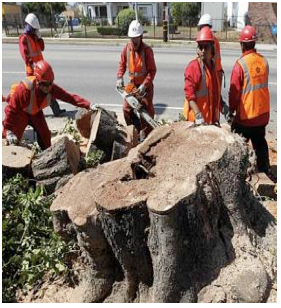
 BOSTICK REPORT-It’s been almost a year and a half since 400 mature trees were cut down in South LA by engineers to clear a path for the space shuttle Endeavor on its way to the California Science Center. This was a tragedy. Urban trees have tremendous economic value, both in actual money savings and in increasing the aesthetic beauty of a neighborhood that often translates into vibrant local economies.
Actual cost savings have been attributed to trees in the city of Los Angeles. Studies estimate that the value of our urban forest, here in LA, to be roughly $12.4 billion dollars. This number is further broken down into categories, including, but not limited to a tree’s ability to filter air pollution, reduce energy costs (both in air conditioning and water savings), and provide additional ground water filtration.
The indirect, or hidden, value of trees resides within a stronger sense of community. Trees provide shade, enticing neighborhood residents to step out into the community even on warmer days.
Combining a healthy urban forest with efforts to increase walkability in an area creates a larger customer base for local entrepreneurs, thereby raising tax revenue for the city and adding value to the properties within the golden range of a 5-8 minute walk of a neighborhood business district. In other words, when you make an area inviting to pedestrians through wider sidewalks, trees strategically placed between the pedestrians and cars to create a psychological sense of safety, and zoning for mixed-use commercial/residential zones within a neighborhood, you foster strong local economies.
The final, and I believe most important contribution that urban trees provide, is lower crime rates. Theories abound as to why this is true, but studies from the University of Vermont have factored that an increase in the urban canopy by roughly 10% results in a decrease in neighborhood crime by roughly 12%.
The value of these trees far outweighed the value of a space shuttle. This spectacle we witnessed 15 months ago was driven by the long-term loss of value those trees provided and these South LA communities really can’t afford to take major steps backwards in exchange for an exhibition that I would argue added very little value to their lives.
People made big promises about replacing these trees. They’ve had enough time to start making things right. So, I’m asking now. Was it worth it and have the trees been replaced?
(Odysseus Bostick is a Los Angeles teacher and former candidate for the Los Angeles City Council. He writes The Bostick Report for CityWatch.)
-cw
CityWatch
Vol 12 Issue 6
Pub: Jan 21, 2014