
(Liz Amsden is a former Angeleno now living in Vermont and a regular CityWatch contributor. She writes on issues she’s passionate about, including social justice, government accountability, and community empowerment. Liz brings a sharp, activist voice to her commentary and continues to engage with Los Angeles civic affairs from afar. She can be reached at [email protected].)

Tackling the Great Pacific Garbage Patch Between Hawaii and the Santa Monica Bay. It’s 2X the Size of Texas
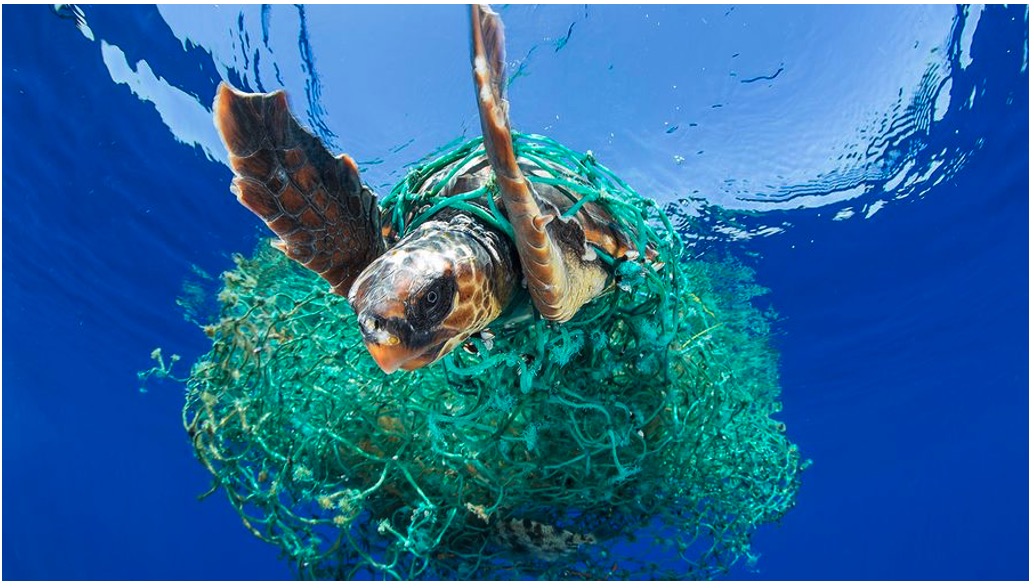
ACCORDING TO LIZ - Trillions of pieces of plastic pollute our oceans today, and the problem is accelerating. Plastics persist for many decades, continuously degrading into microplastics, which are ingested by marine wildlife and are already having a deleterious effect on ecosystems, including the human food chain.
Plastic pollution is a global crisis requiring urgent action.
The infamous Great Pacific Garbage Patch of marine debris in the north Pacific Ocean between Hawai’i and California has a mirror image minor vortex in the ocean off Japan.
Their contents originate from all Pacific Rim countries. Essentially neither is a floating island of garbage; the low density of the accumulated human trash – four particles per cubic metre – prevents detection by satellite imagery and remains unseen by many boaters and divers in the area because it’s so dispersed and numbers-wise comprised primarily of fingernail-sized or smaller, often microscopic, particles suspended in the upper water.
While microplastics dominate the area by count, 92% of the mass of the patch consists of larger objects. Some over 50 years old.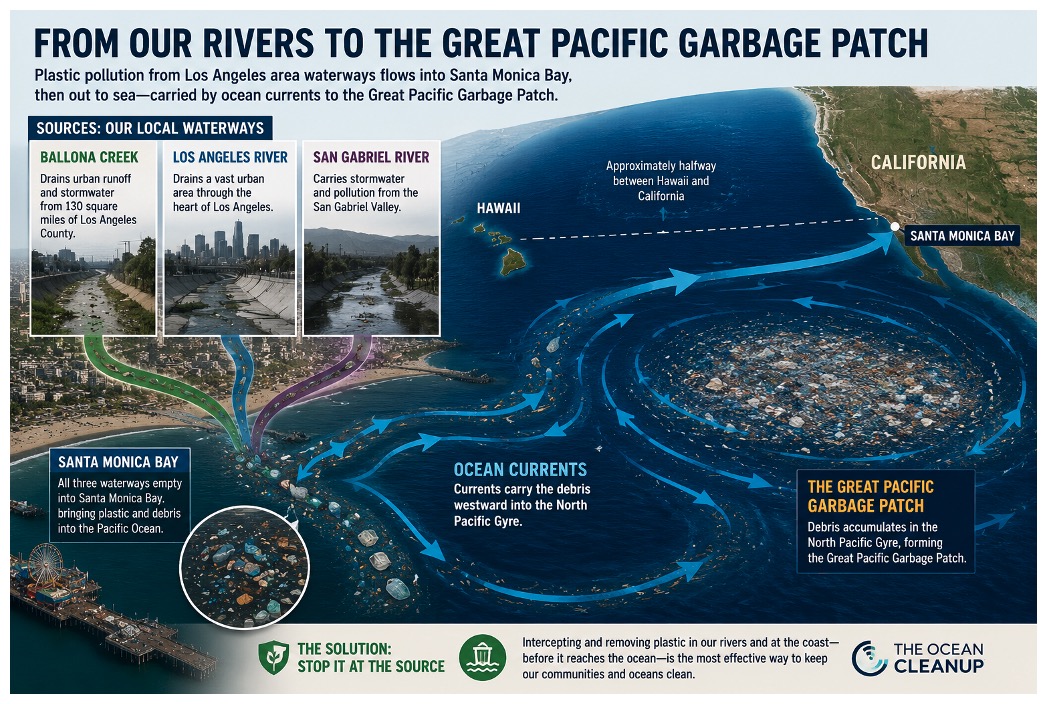
In 2018, the Great Pacific Garbage Patch off Hawai’i consisted of 50,000 to 142,000 tons of plastic, but has since ballooned to over twice the size of Texas with researchers reporting the patch now covers 620,000 square miles.
Ocean Cleanup, a non-profit organization dedicated to developing and scaling solutions to rid the oceans of plastic, undertook to remove 90% of floating ocean garbage by 2040.
By the end of 2024, it had removed more than one million pounds of trash from the patch but that represents only 0.5% of the total… and research shows the patch is exponentially expanding, self-enlarging ten-fold a decade since 1945.
To achieve their objective, Ocean Cleanup is now focusing on the sources of plastics – from coastal ecosystems, rivers and waterways, in addition to continuing to round up existing rubbish from the patches.
Additionally, the organization and local partners advocate for stronger plastics laws and regulations – domestically, nationally, and around the world. But these take time to implement and longer to have significant impact.
California plastics restrictions passed in 2022 to reduce the amount of plastic in single-use packaging 25 percent by January of next year, increase recyclability to 40 percent by 2030, and require all packaging be either recyclable or compostable by 2032.
While environmental groups complain the actual rules have weakened the intent of the legislation and opened loopholes for scofflaws, 17 states including Florida and Texas as well as the National Association of Wholesaler
Distributors have sued claiming the California regulations will increase product cost hurting their profitability and consumers’ wallets.
In the same way that the Golden State’s vehicle emissions standards augmented prices and reduced pollution improving health nationwide.
For over ten years, Ocean Cleanup have been researching and monitoring plastic pollution in oceans and rivers. The results show 90% of all marine pollution flows from rivers, and that only a thousand of the three million rivers worldwide are responsible for 80% of plastics entering our oceans.
Intercepting plastic in rivers is therefore far more cost-effective than dealing with the consequences after it spreads across the vastness of the oceans.
Rivers are the faucets running into the ocean that must be turned off at the source before the Great Pacific Garbage Patch and its burgeoning brethren can be cleaned up once and for all.
So, the Ocean Cleanup is tackling those thousand rivers to close the tap on polluting waterways through its interceptors as well as cleaning up legacy plastic on coasts.
Currently it operates 21 Interceptor systems in ten locations including Malaysia, Indonesia, Vietnam, Guatemala, Jamaica and the Dominican Republic with the intent of purging the 30 most-polluted cities by 2030.
One such behemoth floats where Ballona Creek meets Santa Monica Bay draining 130 square miles of primarily urban Los Angeles County of water… and pollution. A tennis court-sized barge with six giant waste bins sitting on top, it prevented 143,710 pounds of primarily plastic garbage from entering the Pacific in 2025.
Ocean Cleanup’s founder, the Dutch inventor and entrepreneur Boyan Slat, developed technologies to skim garbage crud off the surface of water in order to wage war on the Giant Pacific Garbage Patch. Design of the non-profit’s autonomous boat started in 2017. The pilot project in LA began in 2022 at a cost of $2.8 million including design, permits, and implementation; maintenance runs about $650,000 annually. There is no charge to LA County for use of the Interceptor.
A floating barrier directs rubbish into a smaller platform inside the larger boat where a conveyor belt scoops it up and an automated shuttle distributes it into six dumpsters on an adjacent barge. Overhead solar panels power the operation.
Waste is pulled out, sorted and sent to refuse facilities in a responsible way to avoid its re-entry creating a circular trash loop
Harm to maritime wildlife is minimalized and vastly offset by the system’s amelioration of marine ecosystems.
Ocean Cleanup’s scientists use smart technologies – drones, GPS trackers, remote cameras, and time-lapse surveys – to identify the best approach for each city’s waterways, and encourage local participation to help communities reclaim their environment, and to identify where future Interceptors should be deployed for maximum impact.
Investigating the composition of the trash – polystyrene takeaway containers, noodle cups, bottle caps, vegetarian decorated with microplastics – helps determine its origin and inform educational and policy actions with local partners to further reduce plastic pollution.
Their goal is to clean up an entire area to maximally impact neighborhoods and the environment.
The Ballona Interceptor has already had demonstrable impact on the coastal communities south of the estuary including reduced budgets for beach grooming since; with less garbage drifting out to sea and returned by the tides the waterfront doesn’t have to be cleaned as often.
What looks simple and straightforward hides the prowess of the technology and engineering engaged in fighting the modern plague of plastics.
In May, Ocean Cleanup in conjunction with LA County announced the launch of two more boats – in the San Gabriel River and the Los Angeles River – to further reduce the spread of plastic waste in advance of the LA28 Olympic Games.
As Janet Hahn says: “It’s never been fair that one city’s trash has become another city’s problem.”
Planetwide, marine ecosystems provide benefits of up to $50 trillion a year, directly through fishing, recreation and tourism, and indirectly by water cleaning and marine life enhancements provided by coral reefs, mangrove forests, and other ecosystem architecture.
Unfortunately, global losses due to land use abuse also runs into the trillions with plastics pollution estimated at as high as $2.5 trillion yearly, impacting not only biodiversity and oceanic sustainability but also the health of human communities.