
GAMING - When travelling from Los Angeles for a long weekend in Las Vegas, the veterans of the gaming floor will offer you pearls of wisdom as to the best tactics and strategies to maximize your chances of winning in a casino.
The truth is that these rarely have any equity: ultimately, games like roulette are governed by random chance and unpredictability. There are, however, staking systems designed to apply some context and organization to your play.
Staking systems in gambling are structured methods used to decide how much to bet on each wager, with the aim of controlling risk or increasing potential profits. These systems may be fixed (for example, a flat $10 stake), proportional (such as staking 2% of your bankroll), or progressive (where the stake changes depending on whether the previous bet resulted in a win or a loss), and can be deployed both in land-based establishments or online, with web-based casinos like LeoVegas providing opportunities to play blackjack, roulette, slots, baccarat, and many more games.
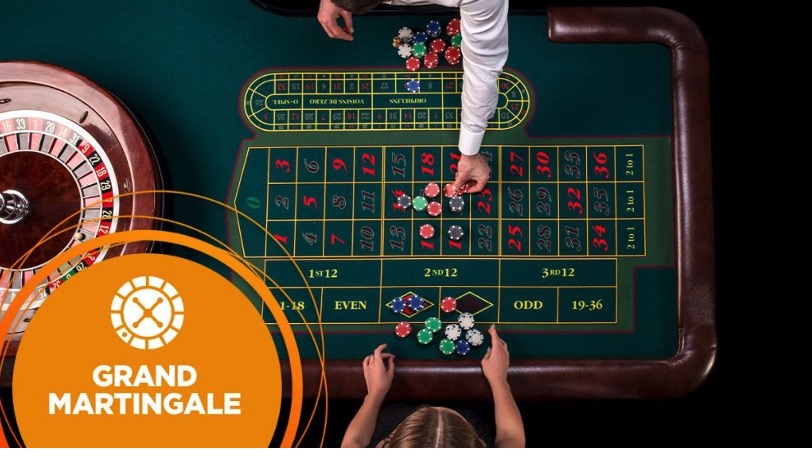
One of popular progressive staking systems is the Grand Martingale, which is a high-risk strategy that is designed to claw back losses and secure a win with each turn at the table. Let’s take a closer look at it, answering the all-important question: does it actually work?
What is the Grand Martingale System?
An offshoot of the popular Martingale staking system, the Grand Martingale elevates the original plan to a new level. The general idea behind is that for each loss at the roulette wheel or blackjack table, players increase their stakes accordingly to wipe out those losses and return to profit.
Let’s imagine you’re betting on red or black at the roulette wheel. You stake $5 on red, but unfortunately the ball lands in black. Under the tenets of the classic Martingale staking system, you would bet again at double your original stake – in this example, $10.
The idea is that if you win, you recoup your previous losses and make a gain too. So, bet $10 on red and win, you’ll trouser $10 in profit covering the $5 you lost on your first spin.
Theoretically, the Martingale System can be used for long chains of losses – returning players a small profit if they eventually place a winning bet.
The Grand Martingale System, meanwhile, goes further and requires players to double their stake and add an additional unit after each losing bet. Should you win on your next turn, you’ll recoup your previous losses and make extra profit, too.
But, as we learned from the Martingale example, the costs of the Grand Martingale System can soon mount up.
- If you stake $5 and lose, you double the previous stake and add one unit ($5 × 2 + $5 = $15).
- If you lose, your cumulative loss is $5 + $15 = $20. For the third bet, you again double the last stake and add one unit ($15 × 2 + $5 = $35).
- If you lose, your cumulative loss is $20 + $35 = $55. For the fourth bet, you double the last stake and add one unit ($35 × 2 + $5 = $75)
- Suppose this one wins at even money: you receive $75 profit.
Here are total results for the sequence:
- Total staked and lost before the win: $5 + $15 + $35 = $55.
- Profit from winning bet: +$75.
- Net result over the entire progression: $75 − $55 = +$20
However, as you may have guessed, if you embark on a long losing run – doubling your stake each time (classic Martingale) and adding one more unit (Grand Martingale) – it can suddenly become pretty expensive to continue the staking plan and still you can lose it all.
Which Casino Games Can the Grand Martingale System Be Used On?
In theory, the Grand Martingale System can be used on any casino game or even when wagering on sports. However, due to the progressive nature of the staking required, it’s recommended that players only use it on so-called ‘50/50’ bets – such as red/black, odd/even, high/low on the roulette wheel.
That way, it becomes a statistical anomaly if you do embark on a long losing streak. For example, you have a 1 in 32 chance of losing five times in a row when betting red or black at roulette – and a 1 in 1,024 chance of losing ten times consecutively with 50/50 bets.
Does the Grand Martingale System Really Work?
You should remember that no staking system can guarantee a profit in gambling. While the theory behind both the Martingale and the Grand Martingale Systems is solid enough: wipe out losses, and make a unit of profit with a progressive staking plan, in a real world they meet two insurmountable obstacles:
- Table limits: casinos set maximum betting limits to stop players from increasing their stakes indefinitely. Once this ceiling is reached, players can no longer wager enough to recover earlier losses.
- Player bankroll depletion: exponential bet growth is extremely aggressive. For example, starting with a $10 bet and losing just 10 times in a row would require a $10,240 wager to recover the initial $10. It will exhaust the player bankroll and inevitably lead to failure over the long term.
Besides, staking systems only alter the distribution of wins and losses; they do not affect a game’s underlying mathematical expectation. Every casino game includes a built-in house advantage (the “house edge” or “vig”), which guarantees that the operator earns a percentage of all money wagered over time. No staking strategy can transform a negative expected value into a positive one.
Still, for players who fully understand the risks, keep expectations realistic, and view staking strategies as short-term tools for entertainment rather than long-term profit engines, trying them can still feel worthwhile—so long as the cost of failure is accepted upfront.
###