PLANNING WATCH-By State of California law and the City of Los Angeles Charter, Los Angeles must prepare, adopt, maintain, and monitor its General Plan, even though its chapters (i.e. elements) on infrastructure and public services are over 50 years old.
But one part of the General Plan, the Housing Element, is perfectly updated.
Based on what we know about the forthcoming 2013-2020 element, the worsening housing crisis, and the market outlook that dominates City Hall housing policy, we need to gird ourselves for a big bamboozle: an updated Housing Element that promotes open-ended real estate speculation. This is particularly ironic because we know a great deal about the housing crisis, and it conflicts with this purpose.
- The current housing crisis is not based on a housing shortage. The root of the housing crisis is economic inequality. If those who are homeless, couch surfing, surviving in cars, and living in overcrowded conditions, had more money, they could move into the growing numbers of vacant apartments.
- The worsening housing crisis does result from the zoning ordinances. These laws rarely change, so they cannot explain rapid fluctuations in homelessness in Los Angeles, California, and the entire United States.
- Increasing the zoning capacity of Los Angeles through the Regional Housing Needs Allocation (RHNA) that the Southern California Association of Governments (SCAG) assigns to local cities will not reduce homelessness. As economists say, “It is impossible to push a string.”
- Building more expensive housing does not reduce homelessness or increase transit ridership, even when the apartments are near mass transit. his is because only the well-off can afford these high-priced rents, and these tenants largely own and drive cars. Even if bus or subways lines are close by, they drive cars or take Ubers.
- While City Hall has poorly responded to the housing crisis, most of the solutions depend on the restoration of Federal housing programs, not such local initiatives as tiny houses and remodeled vacant motels.
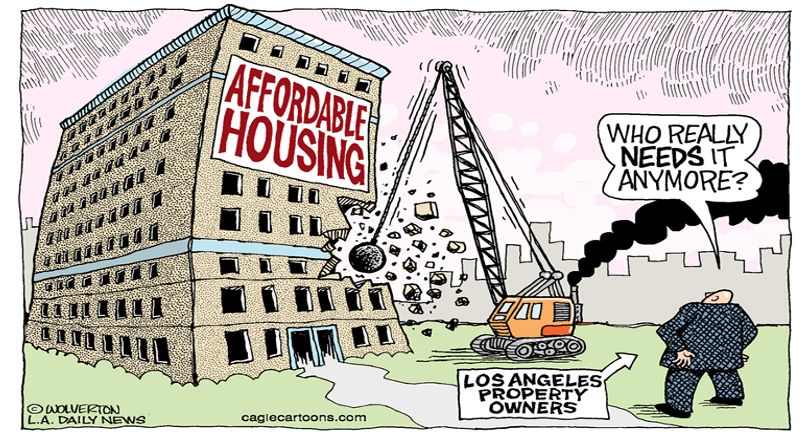
Unless the new Housing Element recognizes these obvious facts, fully supported by two recent studies, the updated Housing Element will become a big bamboozle. When implemented, it will allow high stakes developers to easily build over-sized, over-priced, in-fill apartments that replace existing affordable housing.
Luckily for Angelenos who want to address the housing crisis – not use it as a justification for real estate speculation -- two valuable studies are only a few keystrokes away.
The Economic Roundtable released Locked Out: Unemployment and Homeless in the Covid Economy several days ago. Their new study focuses on economic inequality and totally rejects claims that increasing the overall supply of housing reduces homelessness:
- “Based on the link between unemployment and homelessness, . . . over the next four years the Pandemic recession will cause chronic homelessness to increase 49 percent in the United States, 68 percent in California, and 86 percent in Los Angeles County.
- “The risk of homelessness increases as earnings decrease. The odds of becoming homeless are 23 times greater for a worker at the bottom of the wage ladder than for someone earning $28,000 a year.
- “Increasing the incomes of employable homeless adults through jobs that pay a living wage should be a primary strategy for preventing homelessness caused by the Pandemic Recession.
- “Living wage job creation will give workers the stability to prevent homelessness. In turn, communities will gain essential public projects to improve the environment, build infrastructure, and provide essential social services.”
The second important study is The Vacancy Report: How Los Angeles Leaves Houses Empty and People Unhoused, prepared by UCLA Law School faculty and students, in conjunction with two non-profits, SAJE and ACCE. It found:
- “Our housing system fails to house tens of thousands of the city’s residents and leaves hundreds of thousands more struggling under astronomical rents. But for some, the housing market is working exactly as they would prefer, delivering unprecedented profits to a privileged class of investors who have bent the housing market to their interests. Rampant speculation has resulted in a housing system that works in the interest of a few, to the detriment of the many, along lines of race and class.
- “With more than 36,000 unhoused residents, Los Angeles simultaneously has over 93,000 units sitting vacant, nearly half of which are withheld from the housing market. Thousands of luxury units across the city are empty, owned as second homes or pure investments.
- “Amid an unprecedented shortage of housing for the people who need it most, Los Angeles is building plenty of homes. Unfortunately, much of it is accessible only to the wealthy, with 97% of rental units currently under construction in downtown LA classified by the commercial real estate data service Co-Star in the most expensive and luxurious “4 & 5 star” category, in which rents average over $2,800 per month.
- “Though luxury construction is booming, construction of affordable housing is not. Against a backdrop of mass evictions and displacement, a persistent lack of deeply affordable housing construction has led to a shortfall of more than 500,000 affordable units in Los Angeles County. The gap between the housing that is most needed and the housing that is actually being built continues to widen, intensifying an unprecedented affordable housing crisis.”
If you want to push back against this impending bamboozle, please read these two studies and then share their findings and your conclusions with elected officials.
(Dick Platkin is a former Los Angeles city planner who reports on local planning issues for CityWatch. He serves on the board of United Neighborhoods for Los Angeles (UN4LA) and is co-chair of the new Greater Fairfax Residents Association. Previous Planning Watch columns are available at the CityWatchLA archives. Please send comments and corrections to [email protected].) Prepped for CityWatch by Linda Abrams.